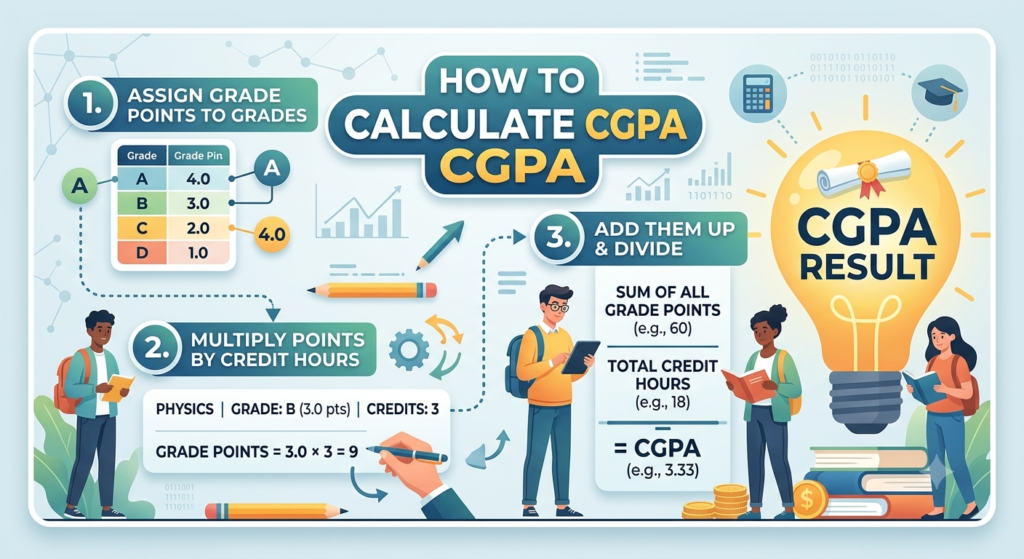
Calculating your CGPA (Cumulative Grade Point Average) is one of the most important ways to track your academic performance throughout your degree program. Whether you are applying for scholarships, internships, higher studies, or jobs, knowing how to calculate CGPA accurately can help you understand your overall academic standing.
Many students know their semester GPA but get confused when calculating their CGPA across multiple semesters. This guide explains how to calculate CGPA for all semesters using simple formulas, examples, and practical tips.
How to Calculate CGPA in 4 Simple Steps
Calculating your CGPA is simple if you know your grade points and credit hours. First, multiply the grade point earned in each course by its credit hours. Next, add all the quality points together. Then, calculate the total credit hours completed. Finally, divide the total quality points by the total credit hours. The result is your CGPA. You can also use our free CGPA Calculator to get accurate results instantly without manual calculations.
What Is CGPA?
CGPA stands for Cumulative Grade Point Average. It represents the overall average of the grade points earned across all completed semesters.
Unlike GPA, which reflects performance in a single semester, CGPA provides a complete picture of your academic achievements throughout your degree.
Universities use CGPA to evaluate:
- Academic performance
- Scholarship eligibility
- Graduation requirements
- Higher education admissions
- Job applications
Why Is CGPA Important?
Your CGPA is often one of the first things employers and universities review.
A strong CGPA can help you:
- Qualify for scholarships
- Secure internships
- Improve job opportunities
- Apply for master’s and PhD programs
- Demonstrate consistent academic performance
Important Before You Calculate
Before calculating your CGPA, remember that universities may use different grading systems such as a 4.0, 5.0, 7.0, or 10.0 scale. Some institutions also have special rules for repeated, withdrawn, or pass/fail courses. The calculation method explained in this guide is the standard approach used by many universities, but you should always check your university’s official grading policy if you are unsure.
CGPA Calculation Formula
The CGPA calculation formula is the standard method used by schools, colleges, and universities to determine a student’s overall academic performance. Although grading systems may vary between institutions, the basic calculation method remains almost the same.
CGPA Formula:
CGPA = Total Grade Points Earned ÷ Total Credit Hours Attempted
To calculate CGPA, first multiply the grade points earned in each course by its credit hours. Then add all the grade points together and divide the result by the total number of credit hours completed.
Example
Suppose you have completed four subjects:
| Subject | Credit Hours | Grade Point |
|---|---|---|
| Mathematics | 3 | 3.8 |
| Physics | 4 | 3.5 |
| Chemistry | 3 | 3.7 |
| English | 2 | 3.9 |
Multiply each grade point by its credit hours:
- Mathematics: 3 × 3.8 = 11.4
- Physics: 4 × 3.5 = 14.0
- Chemistry: 3 × 3.7 = 11.1
- English: 2 × 3.9 = 7.8
Total Grade Points = 44.3
Total Credit Hours = 12
CGPA = 44.3 ÷ 12 = 3.69
This CGPA calculation method provides a more accurate result than simply averaging your grades because it gives greater weight to subjects with more credit hours.
If you want to avoid manual calculations or check your result instantly, you can use our CGPA Calculator, which applies the same formula automatically and reduces the chance of calculation errors.
Quick Tip: Different universities may use different grading scales (such as 4.0, 5.0, or 10.0). While the grading scale can change, the CGPA calculation formula—dividing total weighted grade points by total credit hours—generally remains the same. Always verify your institution’s grading policy if you’re unsure.
Different CGPA Scales Around the World
Although the method of calculating CGPA is generally the same, the grading scale varies from one country and university to another. For example, many universities in Pakistan, the United States, Canada, and Bangladesh use a 4.0 grading scale, while many universities in India use a 10.0 scale. Australia also has universities that use a 7.0 grading scale. Because of these differences, students should avoid comparing CGPAs from different grading systems without using an appropriate conversion method.
How to Calculate CGPA Using Credit Hours
Some universities calculate CGPA using credit hours instead of simple GPA averages.
Formula
CGPA = Total Quality Points ÷ Total Credit Hours
Where:
- Quality Points = Grade Points × Credit Hours
- Total Credit Hours = Sum of all completed course credits
This method provides more accurate results because courses with higher credit hours carry greater weight.
Example of CGPA Calculation with Credit Hours
Consider the following courses:
| Subject | Credit Hours | Grade Point |
|---|---|---|
| Mathematics | 4 | 4.0 |
| English | 3 | 3.7 |
| Physics | 3 | 3.3 |
Calculate Quality Points
Mathematics = 4 × 4.0 = 16
English = 3 × 3.7 = 11.1
Physics = 3 × 3.3 = 9.9
Total Quality Points
16 + 11.1 + 9.9 = 37
Total Credit Hours
4 + 3 + 3 = 10
Calculate CGPA
37 ÷ 10 = 3.70
Final CGPA = 3.70
How to Calculate CGPA in Different Situations
Although the basic CGPA calculation formula remains the same, the steps can vary slightly depending on your academic situation. Whether you’re calculating your overall CGPA, combining multiple semesters, following your university’s grading policy, or using Microsoft Excel, understanding the correct method will help you get accurate results. Below are some of the most common scenarios students search for.
How to Calculate Overall CGPA
If you want to calculate your overall CGPA, you need to include every course you have completed throughout your academic program. Start by multiplying the grade points earned in each subject by its credit hours. Add all of these weighted grade points together, then calculate the total credit hours completed across all semesters. Finally, divide the total grade points by the total credit hours.
This method ensures that courses carrying more credit hours have a greater impact on your final result than courses with fewer credits. Your overall CGPA reflects your cumulative academic performance rather than the results of a single semester.
For example, if you have completed eight semesters, your overall CGPA should include grades from all eight—not just your most recent semester. If manual calculations seem difficult, using an online CGPA calculator can save time and reduce errors.
Don’t want to calculate manually? Try our free CGPA Calculator to get accurate results instantly.
How to Calculate CGPA in University
Most universities use the same principle for calculating CGPA, but the grading scale may differ. Some institutions use a 4.0 scale, while others follow a 5.0 or 10.0 scale. Before calculating your CGPA, check your university’s grading policy to understand how letter grades are converted into grade points.
To calculate your university CGPA, list all completed courses, their credit hours, and the grade points earned. Multiply each grade point by the corresponding credit hours, add the results together, and divide by the total credit hours attempted.
Many universities also exclude withdrawn courses or certain repeated subjects from the calculation, so it’s important to follow your institution’s official academic regulations. When in doubt, compare your result with your university transcript or use a calculator that supports your grading system.
Don’t want to calculate manually? Try our free CGPA Calculator to get accurate results instantly.
How to Calculate CGPA of 2 Semesters
To calculate the CGPA of two semesters, combine the academic records from both semesters instead of averaging the two semester GPAs directly. First, calculate the total weighted grade points earned in Semester 1 and Semester 2. Then add the total credit hours from both semesters.
Use this formula:
CGPA = Total Grade Points from Both Semesters ÷ Total Credit Hours from Both Semesters
For example, if your first semester had 15 credit hours and your second semester had 18 credit hours, the second semester contributes more to your final CGPA because it contains more credit hours. Simply averaging the two GPAs without considering credit hours may produce an inaccurate result.
This method works for any institution that calculates CGPA based on cumulative academic performance.
Don’t want to calculate manually? Try our free CGPA Calculator to get accurate results instantly.
How to Calculate CGPA of 6 Semesters
The process for calculating the CGPA of six semesters is exactly the same as for any cumulative CGPA. Gather the grade points and credit hours from all six semesters, calculate the weighted grade points for each course, and then add everything together.
After finding the total weighted grade points and the total credit hours completed across all six semesters, divide the grade points by the credit hours to obtain your final CGPA.
Students often calculate their CGPA after six semesters to monitor academic progress, determine scholarship eligibility, or estimate graduation requirements. Using all completed semesters provides a much more accurate picture of your academic performance than looking at a single semester alone.
Don’t want to calculate manually? Try our free CGPA Calculator to get accurate results instantly.
How to Calculate CGPA in Excel
Microsoft Excel is a simple way to calculate CGPA, especially if you regularly update your academic record. Create columns for Course Name, Credit Hours, Grade Point, and Weighted Grade Points.
In the weighted grade points column, multiply the credit hours by the grade point for each course. Then use Excel’s SUM function to add all weighted grade points and all credit hours separately. Finally, divide the total weighted grade points by the total credit hours using a formula such as:
=SUM(D2:D10)/SUM(B2:B10)
Excel automatically recalculates your CGPA whenever you update your grades, making it a convenient option for students who want to track their academic performance throughout their degree.
Don’t want to calculate manually? Try our free CGPA Calculator to get accurate results instantly.
How to Calculate CGPA for 8 Semesters
Many degree programs consist of 8 semesters.
Suppose your GPAs are:
| Semester | GPA |
|---|---|
| 1 | 3.20 |
| 2 | 3.40 |
| 3 | 3.50 |
| 4 | 3.60 |
| 5 | 3.70 |
| 6 | 3.80 |
| 7 | 3.90 |
| 8 | 4.00 |
Total GPA
3.20 + 3.40 + 3.50 + 3.60 + 3.70 + 3.80 + 3.90 + 4.00 = 29.10
CGPA
29.10 ÷ 8 = 3.64
Note: this example assumes identical credit hours every semester, which is why a simple average works here. If your credit hours varied semester to semester (the more common case), use the credit-hour-weighted formula above instead, or use our free CGPA Calculator, which handles this automatically for any number of semesters.
Your final CGPA is 3.64.
Common Mistakes When Calculating CGPA
Students often make mistakes that lead to inaccurate results.
Ignoring Credit Hours
Not all subjects have the same weight. Higher-credit courses impact CGPA more.
Using Incorrect Grade Points
Always verify your university’s grading system.
Excluding Failed Courses
Some universities include failed courses in CGPA calculations.
Incorrect GPA Average
Double-check all semester GPAs before calculating.
Forgetting Repeated Courses
Universities may have different policies regarding repeated subjects.
Benefits of Using an Online CGPA Calculator
A CGPA calculator simplifies the entire process.
Benefits include:
Fast Results
Get your CGPA instantly.
Accurate Calculations
Avoid manual errors.
Easy to Use
Simply enter semester GPAs.
Mobile Friendly
Calculate CGPA from any device.
Free Access
No registration required.
Tips to Improve Your CGPA
If your CGPA is lower than expected, you can improve it by:
- Attending classes regularly
- Completing assignments on time
- Focusing on weak subjects
- Following a study schedule
- Practicing past papers
- Managing your time effectively
- Tracking your progress each semester
Consistent improvement in semester GPA can significantly increase your overall CGPA.
Common Mistakes When Calculating CGPA
Students often make mistakes that lead to incorrect CGPA calculations. The most common errors include ignoring credit hours, adding GPAs instead of weighted grade points, using the wrong grading scale, including withdrawn courses, or forgetting to update repeated subjects. Always verify your grades and credit hours before calculating your final CGPA to ensure accurate results.
Manual Calculation vs Online CGPA Calculator
You can calculate your CGPA manually using the formula, but it requires careful calculations and may take time. An online CGPA calculator performs the same calculation instantly, reduces the chance of errors, and saves time. If you already know your grades and credit hours, using an online calculator is the quickest and most accurate option.
Frequently Asked Questions
What is CGPA?
CGPA stands for Cumulative Grade Point Average and represents your overall academic performance across all semesters.
How do I calculate CGPA for all semesters?
Combine every semester’s grade points and credit hours together: multiply each semester’s GPA by that semester’s credit hours, add those weighted totals, then divide by your total credit hours across all semesters. Simply averaging your semester GPAs only gives the same answer if every semester had identical credit hours, which is rarely the case.
Can I calculate CGPA using credit hours?
Yes. Many universities calculate CGPA using total quality points divided by total credit hours.
What is a good CGPA?
Generally, a CGPA above 3.0 on a 4.0 scale or above 7.5 on a 10-point scale is considered good.
Is CGPA more important than GPA?
CGPA is often more important because it reflects your overall academic performance throughout your degree.
Final Tip
It is a good habit to calculate your CGPA after every semester instead of waiting until graduation. Regularly tracking your academic performance helps you identify areas for improvement, stay eligible for scholarships, and prepare for internships or higher education opportunities.
Want to skip manual calculations? Use our free CGPA Calculator to calculate your GPA and CGPA instantly with support for multiple semesters and credit hours.
Conclusion
Learning how to calculate CGPA is essential for every student. Whether your university uses semester GPAs or credit-hour-based grading systems, understanding the calculation process helps you monitor your academic progress and plan for future goals.
Instead of performing lengthy manual calculations, students can use a reliable online CGPA Calculator to calculate their results quickly and accurately. By tracking your performance regularly, you can identify areas for improvement and work toward achieving a higher CGPA throughout your academic journey.