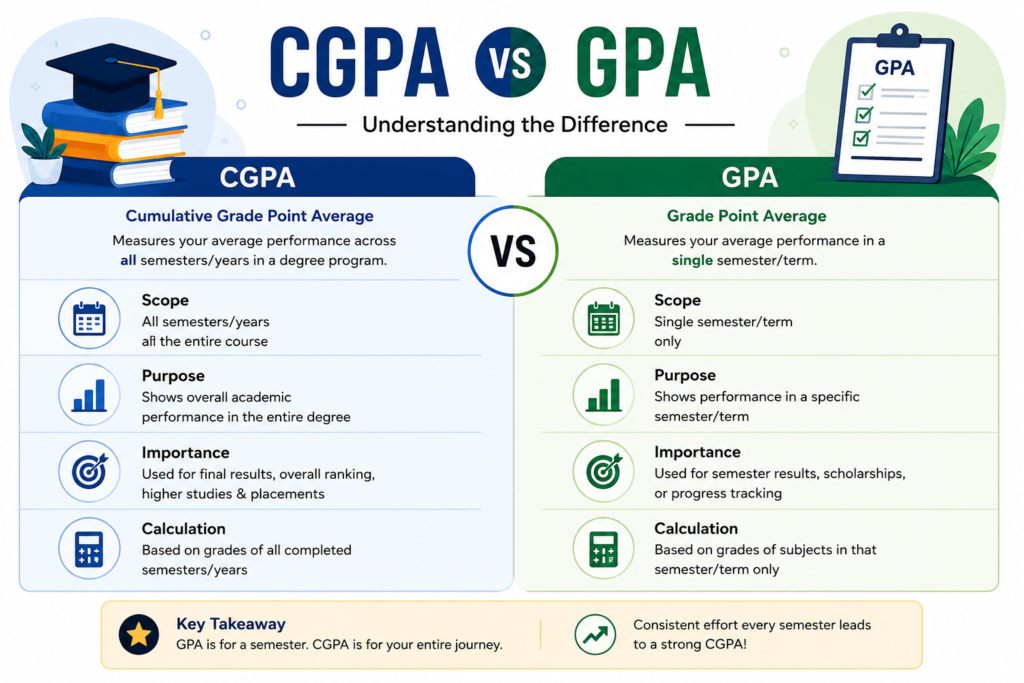
CGPA (Cumulative Grade Point Average) is a single number, usually on a 4.0 or 10.0 scale, that summarizes a student’s academic performance across every semester of their degree. It’s calculated as the credit-hour-weighted average of every grade earned — not a simple average of semester GPAs. Want your exact number? Use our free CGPA Calculator to get it in seconds.
Students often come across the terms CGPA vs GPA when checking their academic performance. Although these terms are closely related, they are not the same. Understanding the difference between CGPA vs GPA is important for university admissions, scholarships, internships, and job applications.
In this guide, we will explain the meaning of CGPA and GPA, how they are calculated, and which one is more important for students.
What Is GPA?
GPA (Grade Point Average) is a measure of a student’s academic performance during a specific semester or term. It represents the average grade points earned in all courses taken during that period.
Universities calculate GPA based on:
- Grade points earned
- Credit hours of each course
- Semester performance
GPA Formula
GPA=Total Credit HoursTotal Quality Points
For example, if a student earns 36 quality points in a semester with 12 credit hours:
GPA = 36 ÷ 12 = 3.0
What Is CGPA?
CGPA (Cumulative Grade Point Average) is the overall average of GPA scores earned across all semesters or academic years.
Unlike GPA, which reflects performance in a single semester, CGPA shows a student’s complete academic record.
CGPA Formula
CGPA = Σ(Semester GPA × Credit Hours) ÷ Σ(Credit Hours) — in plain terms, multiply each semester’s GPA by the credit hours you took that semester, add those together, then divide by your total credit hours across all semesters. This credit-weighted method is what universities actually use, because it ensures a semester where you took more courses counts proportionally more than a lighter semester. (A simple average of semester GPAs only gives the same answer if every semester has identical credit hours, which is rarely the case.)
For example, with different credit hours each semester:
- Semester 1: GPA 3.4, 15 credit hours
- Semester 2: GPA 3.6, 18 credit hours
- Semester 3: GPA 3.8, 15 credit hours
CGPA = [(3.4 × 15) + (3.6 × 18) + (3.8 × 15)] ÷ (15 + 18 + 15) = (51 + 64.8 + 57) ÷ 48 = 172.8 ÷ 48 = 3.60
CGPA vs GPA: Key Differences
| Feature | GPA | CGPA |
|---|---|---|
| Full Form | Grade Point Average | Cumulative Grade Point Average |
| Covers | One semester or term | Entire academic program |
| Purpose | Measures short-term performance | Measures overall performance |
| Calculation | Based on semester grades | Based on all semester GPAs |
| Updates | Every semester | Changes throughout the degree |
| Importance | Semester evaluation | Final academic record |
Want SGPA and percentage in the mix too? See our full CGPA vs GPA vs SGPA vs Percentage comparison guide for a side-by-side breakdown of all four.
Why GPA Is Important
GPA helps students evaluate their performance during a particular semester.
Benefits of GPA include:
- Identifies academic strengths and weaknesses
- Helps track semester performance
- Used for semester scholarships
- Encourages academic improvement
Students can use a GPA calculator to estimate their semester results before official grades are released.
Why CGPA Is Important
CGPA is often considered more important because it reflects long-term academic consistency.
A strong CGPA can help with:
- University admissions
- Scholarships
- Higher education applications
- Internship opportunities
- Job placements
Many employers and universities review CGPA before making decisions.
GPA to CGPA Conversion
Students often wonder how GPA is converted into CGPA.
The accurate process, accounting for credit hours, works like this:
- Calculate GPA for each semester.
- Multiply each semester’s GPA by that semester’s credit hours.
- Add up those weighted totals, then divide by your total credit hours across all semesters.
For example, with credit hours included:
| Semester | GPA | Credit Hours |
|---|---|---|
| Semester 1 | 3.5 | 16 |
| Semester 2 | 3.7 | 15 |
| Semester 3 | 3.6 | 18 |
| Semester 4 | 3.8 | 15 |
Total weighted quality points = (3.5×16) + (3.7×15) + (3.6×18) + (3.8×15) = 56 + 55.5 + 64.8 + 57 = 233.3
CGPA = 233.3 ÷ (16+15+18+15) = 233.3 ÷ 64 = 3.65
Which Is More Important: CGPA vs GPA?
Both are important, but they serve different purposes.
GPA Is Important For:
- Semester performance reviews
- Academic probation checks
- Semester-based scholarships
CGPA Is Important For:
- Graduation requirements
- Higher studies
- Competitive scholarships
- Job applications
In most cases, employers and universities focus more on CGPA because it represents overall academic performance.
What Is Considered a Good GPA?
Generally:
- 2.5 GPA = Average
- 3.0 GPA = Good
- 3.5 GPA = Very Good
- 3.8+ GPA = Excellent
The exact standards may vary by institution.
What Is Considered a Good CGPA?
On a 4.0 scale:
- 3.0+ CGPA = Good
- 3.5+ CGPA = Very Good
- 3.8+ CGPA = Excellent
On a 10-point scale:
- 7.0+ CGPA = Good
- 8.0+ CGPA = Very Good
- 9.0+ CGPA = Excellent
Good CGPA by Country
| Country / System | Scale | Good CGPA |
|---|---|---|
| Pakistan (HEC) | 4.0 | 3.0+ |
| India | 10.0 | 7.5+ |
| USA | 4.0 | 3.0-3.5+ |
| UK (Honours-equivalent) | First/2:1/2:2 | 2:1 or above |
These are general benchmarks, not universal rules — always check your specific university’s grading policy, since HEC-regulated Pakistani universities in particular can have their own probation and Dean’s List thresholds. See our PU, UAF, COMSATS, and NUST grading policy guides for exact figures.
Common Mistakes Students Make
When calculating CGPA vs GPA, students often:
- Ignore credit hours
- Use incorrect grade points
- Forget repeated courses
- Miscalculate semester averages
- Use unofficial conversion formulas
Using an online GPA or CGPA calculator can help avoid these mistakes.
Frequently Asked Questions
Is CGPA vs GPA the same?
No. GPA measures performance for one semester, while CGPA measures performance across all semesters.
Which is higher, GPA or CGPA?
Neither is automatically higher. CGPA is the credit-hour-weighted average across all semester GPAs, not a simple average – so it depends on how your credit hours were distributed.
Can CGPA change every semester?
Yes. As new semester GPAs are added, the CGPA may increase or decrease.
Do employers look at CGPA vs GPA?
Most employers focus on CGPA because it reflects overall academic performance.
How can I improve my CGPA?
You can improve your CGPA by earning higher GPAs in future semesters, maintaining regular attendance, and following effective study habits.
Conclusion
Understanding the difference between CGPA vs GPA is essential for every student. GPA measures academic performance in a single semester, while CGPA reflects overall performance throughout a degree program.
Both metrics are important, but CGPA is usually given more weight by universities, scholarship committees, and employers. By tracking your GPA regularly and maintaining strong academic performance, you can gradually improve your CGPA and achieve your educational goals.
To calculate your GPA, SGPA, or CGPA instantly, use the free tools available on CGPACal.com and monitor your academic progress with confidence.