Search any Pakistani Universities student forum and the CGPA conversation follows a predictable arc: first “how does grading even work here,” then “does my university’s name actually matter,” then — for a huge number of students — “my CGPA is low, is my future over.” This guide follows that same arc, answering the real questions students ask, in the order they usually come up.
Check your exact number instantly with our CGPA Calculator, built specifically around Pakistani university grading scales — including for students whose universities (like PU) don’t reissue old marksheets.
How does the grading system work in Pakistani universities?
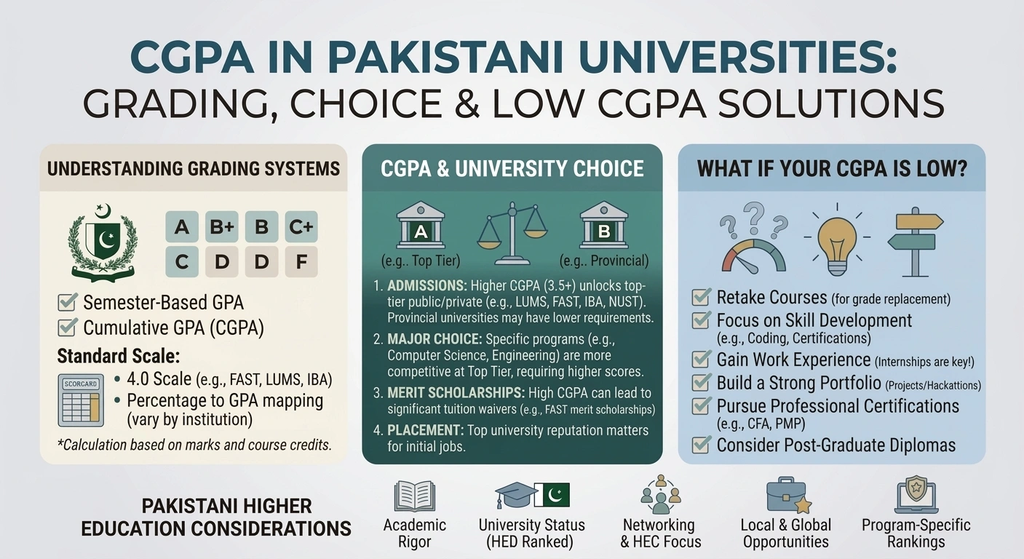
Most Pakistani universities follow the HEC’s 4.0 GPA scale, converting percentage or letter grades into grade points per course, then weighting by credit hours to get your GPA (per semester) and CGPA (cumulative). A rough conversion many universities use:
- 85%+ → A (4.0)
- 80–84% → A- (3.7)
- 75–79% → B+ (3.3)
- 70–74% → B (3.0)
- and so on down to the passing threshold (commonly 50% / C-)
Relative grading, used at some institutions like FAST and GIKI, adjusts these cutoffs based on the class’s overall performance in that specific course — so an 80% might land you an A in one section and a B+ in another, depending on the class average. This is why “how is CGPA counted at [my university]” often has a different literal answer than the general HEC formula — always check your own university’s official grading policy alongside the general formula.
Converting CGPA to percentage works in reverse using the same table, though it’s an approximation — official transcripts from your university are the authoritative source if percentage is required for a specific application.
Does GPA or university name actually matter after graduation?
Both matter, but their weight changes fast over time:
- First job / fresh graduate hiring: GPA and university name matter most here, since recruiters have little else to judge you on. A recognized university name can get your resume shortlisted faster.
- After your first 1–2 jobs: Work experience, projects, and skills take over almost entirely. Almost nobody asks a mid-career software engineer for their CGPA.
- Higher education abroad: University reputation and CGPA both factor into admission decisions, alongside test scores and research/work experience.
So the honest answer to “does university matter” is: mostly for the first door, not for the whole career. What you build once you’re in the industry matters more the further you get from graduation.
NUST vs GIKI vs FAST vs Air University — which is best for CGPA and career outcomes?
There’s no single “best” — each trades off differently:
- NUST — Strong industry recognition within Pakistan, broad alumni network, generally considered rigorous grading.
- GIKI — Smaller, tightly-knit engineering-focused environment; many students report it’s genuinely harder to maintain a high GPA here due to grading rigor and workload.
- FAST — Strong CS/software reputation and industry placement within Pakistan, relative grading system, but some students report the environment is less oriented toward students planning to study abroad — if that’s your specific goal, check how well recent graduates have placed into abroad Masters programs before deciding.
- Air University — Generally considered a solid second-tier option, competitive for specific programs like FinTech.
If your priority is maximizing GPA specifically, ask current students directly about grading rigor in your intended department — it varies more by department than by university brand. If your priority is a specific outcome (local job, abroad Masters, research), work backward from that goal and check recent alumni outcomes rather than picking on ranking alone.
For virtual vs Tier-3 physical universities: a recognized physical university generally carries more weight for both local hiring and abroad applications, primarily because of accreditation clarity, campus resources, and networking — virtual or lesser-known Tier-3 institutions can still work, but expect to compensate more with projects, certifications, and portfolio work.
My CGPA is low (1.96–2.99 range) — what should I actually do?
A low CGPA in an early semester (like 1.96 in semester 1) is recoverable — CGPA math means earlier low semesters have more remaining semesters to average against. Concretely:
- Diagnose the cause first — was it workload, a specific weak subject area, personal circumstances, or study method? The fix differs for each.
- Front-load your improvement — the earlier you raise your semester GPA, the more it lifts your overall CGPA, since later semesters carry proportionally less weight the more credit hours you’ve already banked.
- Talk to your department about retake or improvement-exam policies — many Pakistani universities allow repeating a course to replace a poor grade.
- Model your realistic ceiling — plug your current CGPA and remaining credit hours into a CGPA calculator to see exactly what GPA you’d need each remaining semester to hit your target.
On transferring Pakistani Universities over a bad first semester (e.g., FAST to NUST): transferring resets your CGPA calculation at most institutions but doesn’t erase the underlying issue that caused the low semester — worth confirming transfer credit and CGPA-reset policy directly with the receiving university’s admissions office before deciding.
On the “missed 3.00 by 0.01, university won’t round it” situation: rounding policies are set at the university/registrar level with essentially no standard — if it matters for a specific job or scholarship cutoff, it’s worth formally requesting a policy exception in writing, since these decisions are sometimes reversed at the registrar level, but there’s no universal fix.
I have a high CGPA but feel unprepared for the industry — what now?
A high CGPA (3.7+) with a feeling of being “unemployable” is common and fixable — it usually means the academic side is strong but practical signals (projects, internships, contributions, portfolio) are thin. From here, the highest-leverage moves are typically: build 2–3 real projects you can explain in depth in an interview, get any internship (even unpaid or short-term) for genuine work-environment exposure, and start applying before you feel “ready” — interview experience itself is a skill that compounds.
How much CGPA do I need for a Masters abroad (Germany, Australia, Canada, etc.) from Pakistan?
Requirements vary by country and program tier:
- Germany: Many public university Masters programs (especially in engineering/IT) accept CGPA in the 3.0+ range (out of 4.0), and some technical Pakistani Universities weigh entrance tests or relevant coursework alongside CGPA rather than using a strict cutoff.
- Australia: Most Masters programs look for roughly 3.0/4.0 (or equivalent), though competitive programs and scholarships often expect higher.
- Canada: Typically similar to Australia — 3.0/4.0 as a common baseline, higher for funded or research-track positions.
For CGPA around 2.30–2.6, options narrow but aren’t closed — look at Pakistani Universities with holistic admission review, bridge/pathway programs, or programs in less oversubscribed specializations, and lean on relevant work experience or a strong SOP to contextualize the transcript. A single F grade on an otherwise ~3.3 average transcript is usually a minor factor in holistic review, especially if it’s an early-semester outlier rather than a pattern — but always check the specific program’s stated policy on grade minimums and transcript review.
For CGPA requirement direction the other way — a Bangladeshi (or other international) student applying for a Masters in Pakistan with a 3.0 CGPA: this is generally competitive for most public-sector scholarship programs, which commonly set minimums around 2.5–3.0/4.0, though exact eligibility depends on the specific scholarship’s published criteria.
Where can I find CGPA-based scholarship requirements (e.g., Honhaar)?
Scholarship GPA/CGPA thresholds (like Pakistan’s Honhaar scholarship) are set individually per program and can change by cycle — always check the current official notification for exact CGPA cutoffs rather than relying on past-year numbers from forums, since eligibility criteria and quotas are revised periodically.
Bottom line: Grading systems in Pakistan generally follow the HEC 4.0 scale with some Pakistani Universities layering relative grading on top. University name and GPA matter most early in your career and for abroad admissions, then fade in importance. A low CGPA is mathematically recoverable the earlier you address it, and most CGPA-for-abroad thresholds sit around 3.0/4.0 — below that, options narrow but don’t disappear.