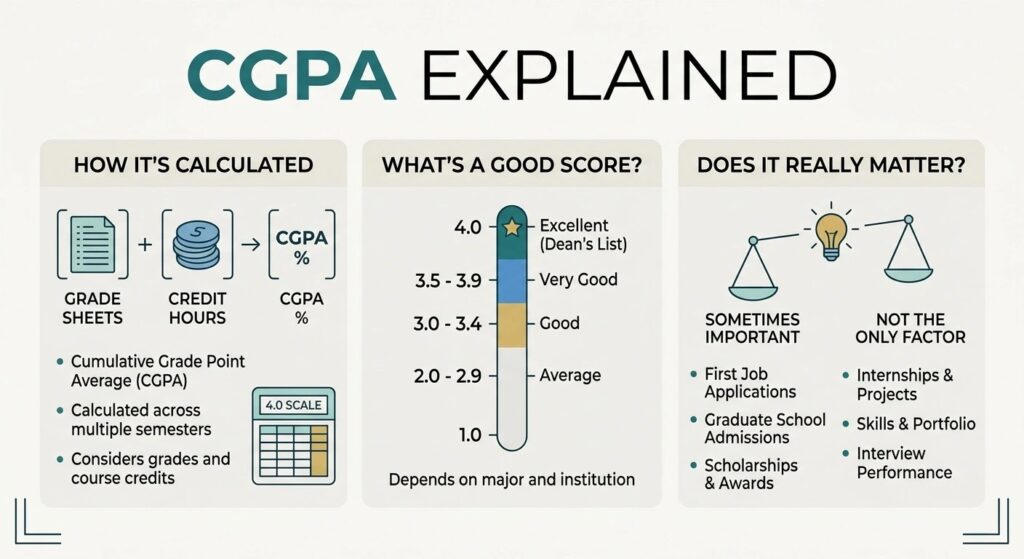
If you’ve ever typed “how does CGPA even work” into Google at 1 a.m. before a transcript deadline, you’re not alone. Every semester, thousands of students ask almost the exact same handful of questions — what counts as a “good” CGPA explained, whether it can actually make or break a career, and how to calculate it without messing up the math. This guide pulls together the real questions students keep asking and answers them in order — starting with the basics, moving to what a good score actually means, and ending with the career-impact question everyone really wants answered.
Use our free CGPA Calculator to work out your exact number in seconds instead of doing it by hand.
What is the difference between GPA and CGPA explained?
GPA (Grade Point Average) measures your performance in a single semester — it resets every term. CGPA (Cumulative GPA) is the running average across every semester you’ve completed so far. Think of GPA as a snapshot and CGPA as the full-movie average. Some universities also track “Sessional GPA,” which is just another name for a single semester’s GPA before it gets folded into your CGPA.
How does CGPA work, and how is it calculated?
CGPA works by weighting each course’s grade point by its credit hours, adding those up, and dividing by the total credit hours attempted across all completed semesters.
The formula:
CGPA = (Σ of [Grade Point × Credit Hours] for every course so far) ÷ (Total Credit Hours attempted)
To calculate it yourself:
- Convert each course grade (A, B+, C, etc.) into its grade point using your university’s official scale (most Pakistani universities use the HEC 4.0 scale).
- Multiply each grade point by that course’s credit hours.
- Add up those totals across all your semesters.
- Divide by your total credit hours.
This is also the exact logic behind SGPA (per-semester) vs CGPA (cumulative) — SGPA uses only the current semester’s courses, CGPA uses all of them. If the manual math feels tedious, our CGPA calculator does steps 1–4 automatically per semester and cumulatively.
What CGPA is considered good — or good enough to get hired?
There’s no single universal cutoff, but general benchmarks most recruiters and universities work with:
- 3.5–4.0 — Excellent, competitive for top employers, scholarships, and grad school
- 3.0–3.49 — Good, solid for most corporate and graduate-program applications
- 2.5–2.99 — Average, acceptable for many roles but may need to be offset by internships, projects, or interview performance
- Below 2.5 — Often the minimum threshold some employers and grad programs screen out at
Most Pakistani employers and universities treat 3.0+ as “safe” and 3.5+ as genuinely strong. What’s “good enough to graduate with” depends more on your field — engineering and CS programs sometimes weight CGPA more heavily in early screening than business or humanities do.
Does CGPA affect your future career — and how much?
CGPA explained mostly matters at the first filter — fresh-graduate hiring, scholarship shortlisting, and grad school admissions, where recruiters have nothing else to judge you on yet. Once you have work experience, internships, or a portfolio, its weight drops fast — most employers stop asking for it after your first job or two.
So the honest answer: CGPA opens or closes the first door. What you do once you’re through it matters far more long-term.
Is CGPA — or society positions and competition experience — really what gets you a high-paying job in business?
In business fields specifically, no single factor dominates. Recruiters for high-paying roles typically weigh a mix of:
- CGPA (as a baseline screening filter, especially for fresh graduates)
- Internship quality and relevant work experience
- Leadership roles in societies, clubs, or competitions (signals initiative and soft skills)
- Networking and referrals (often underrated but genuinely decisive)
- Interview and case-study performance
A strong CGPA explained gets your resume looked at. Society leadership and competition wins get you talked about in the interview room. Neither replaces the other — they solve different problems in the hiring process.
Is a CGPA like 3.37 or 3.74 mediocre — and can it realistically be raised to 3.8–4.0?
A 3.37 or 3.74 is solidly good by most scales, not mediocre — but “can I raise it” is really a math question, and the answer depends entirely on how many credit hours you have left.
The fewer semesters remaining, the smaller your CGPA explained can move, because your existing credit hours already carry heavy weight in the average. As a rough rule: if you’re in your final year with only 1–2 semesters left, moving from 3.37 to 3.8 would require near-perfect grades in every remaining course — mathematically possible but demanding. Earlier in your degree, with more semesters ahead, the same jump is far more achievable.
Rather than guessing, plug your current CGPA and remaining credit hours into a CGPA calculator and test different “what if I get all A’s next semester” scenarios — it’ll show you exactly what’s mathematically realistic for your situation.
Bottom line: CGPA is simple arithmetic with outsized psychological weight. Know how it’s calculated, aim for 3.0+ as a safe baseline and 3.5+ if you’re chasing competitive opportunities, and remember it’s a door-opener — not the whole career.