Credit hours in Pakistan confuse almost every new university student, and I was no different. On the first day of my BS, I opened my course outline and saw “Programming Fundamentals 4(3-1)” next to “Islamic Studies 2(2-0)”. I had no idea what the brackets meant. I also didn’t know why a single lab could decide whether my semester GPA looked good or terrible.
If you’re in the same place, this guide is for you. We’ll cover what credit hours actually are, how to read codes like 3(2-1), how many credit hours you need for a BS under HEC rules, and why credit hours matter more for your CGPA than most students realise.
What Are Credit Hours in Pakistan? (Quick Answer)
A credit hour is the unit Pakistani universities use to measure the weight of a course. For a theory course, 1 credit hour means about 1 hour of class per week for the whole semester. For a lab, 1 credit hour usually means 3 hours of lab per week.
A 3-credit course counts three times as much in your GPA as a 1-credit course. That’s the whole reason credit hours matter.
Credit Hours Meaning in Simple Words
Think of credit hours as the “weight” of each subject.
- A 3 credit hour course = heavy subject, big impact on your GPA
- A 1 credit hour course (often a lab) = light subject, small impact on your GPA
- A non-credit course = you must pass it, but it doesn’t affect your GPA at all
Your university records two numbers every semester:
- Credit hours attempted: every credit course you enrolled in
- Credit hours earned: only the courses you passed
To graduate, you need enough earned credit hours. That’s why the total on your transcript matters so much.
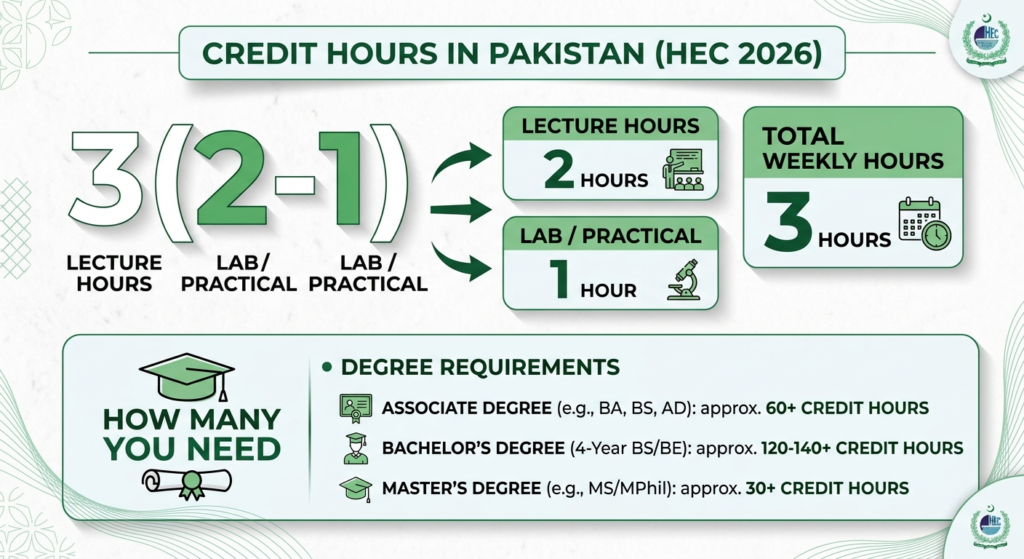
How to Read 3(3-0), 3(2-1) and 4(3-1)
This notation is used across Pakistani universities, and it confuses almost every first-semester student. The format is:
Total credit hours (Theory credits – Lab credits)
| Course code | Total credits | Theory | Lab | Weekly class time (typical) |
|---|---|---|---|---|
| 3(3-0) | 3 | 3 | 0 | 3 hours of lectures |
| 3(2-1) | 3 | 2 | 1 | 2 hours lectures + 3 hours lab = 5 hours |
| 4(3-1) | 4 | 3 | 1 | 3 hours lectures + 3 hours lab = 6 hours |
| 2(2-0) | 2 | 2 | 0 | 2 hours of lectures |
| 1(0-1) | 1 | 0 | 1 | 3 hours of lab |
3(2-1) Credit Hours Meaning
3(2-1) means a 3 credit hour course made of 2 credit hours of theory and 1 credit hour of lab. You attend around 2 hours of lectures and one 3-hour lab session every week. Both parts together make up one grade on your transcript at most universities.
3(3-0) Meaning
3(3-0) means a pure theory course of 3 credit hours with no lab. Examples include English, Pakistan Studies, and most management or social science subjects.
4(3-1) Meaning
4(3-1) means 3 theory credits plus 1 lab credit, for a total of 4. This is common for programming, physics, and chemistry courses. Because it carries 4 credits, a bad grade here hurts your GPA more than a bad grade in a 2-credit course.
1 Credit Hour Means How Many Hours?
This is one of the most searched questions, and the honest answer is that it depends on the course type:
- Theory: 1 credit hour = 1 contact hour per week (some universities count a 50-minute period as one hour)
- Lab / practical: 1 credit hour = 3 contact hours per week at most Pakistani universities (a few use 2)
- Per semester: multiply the weekly hours by roughly 16 teaching weeks
So a 3-credit theory course is about 48 hours of classroom time in a semester. That doesn’t include your self-study. Most teachers expect roughly 2 hours of self-study for every hour in class.
Credit Hours vs Contact Hours
- Credit hours = weight of the course in your GPA and degree total
- Contact hours = actual time you spend in class or lab each week
A 3(2-1) course has 3 credit hours but 5 contact hours. That’s why lab-heavy semesters feel so exhausting even when your credit hour total looks normal.
How Many Credit Hours in BS in Pakistan?
Under HEC’s Undergraduate Education Policy 2023 (V1.1), which universities had to adopt from Fall 2023, a BS or equivalent degree needs 120 to 144 credit hours. You can read the policy on the official HEC page.
Here’s what that looks like in practice:
| Program | Typical total credit hours |
|---|---|
| BS (4 years, 8 semesters) | 120–144 |
| BE / BSc Engineering (PEC-accredited) | Usually near the upper end of the range |
| MS / MPhil | 30 (usually 24 coursework + 6 thesis) |
| PhD | 18 credit hours of coursework, plus research |
Your exact number is set by your university and program. It’s printed in your degree scheme or prospectus, so check there first.
Want to see how close you are to graduating? Enter your earned credits in our Credit Hour Calculator to see what’s left.
Credit Hours Per Semester in Pakistan
HEC’s policy sets a normal load of 15–18 credit hours per semester. Universities may allow up to 21 credit hours only where a specific program requires it.
A simple way to picture it:
- 15 credits = 5 courses of 3 credits each (a comfortable load)
- 18 credits = 6 courses of 3 credits, or a mix with labs (standard for many programs)
- 19–21 credits = overload; usually needs approval and often a good CGPA
Summer Semester Credit Hours
Summer semesters are shorter, so universities cap them tightly. The cap is often around 6–9 credit hours, but rules vary. Summer is mostly used to repeat failed courses or clear backlogs. Check your university’s summer policy before planning on it.
If you’re mapping out future semesters, the Semester Planner helps you spread heavy and light courses sensibly.
How Credit Hours Affect Your CGPA
This is where credit hours stop being boring. Your GPA and CGPA are credit-weighted averages. A course with more credit hours pulls your average more strongly.
Formula:
GPA = Σ (Grade Point × Credit Hours) ÷ Σ (Credit Hours)
Example: Same Grades, Different Credit Hours
| Course | Credits | Grade point | Quality points |
|---|---|---|---|
| Programming Fundamentals 4(3-1) | 4 | 2.0 | 8.0 |
| Calculus 3(3-0) | 3 | 4.0 | 12.0 |
| English 3(3-0) | 3 | 4.0 | 12.0 |
| Islamic Studies 2(2-0) | 2 | 4.0 | 8.0 |
| Total | 12 | 40.0 |
GPA = 40 ÷ 12 = 3.33
Now swap the bad grade to the 2-credit course instead:
| Course | Credits | Grade point | Quality points |
|---|---|---|---|
| Programming Fundamentals 4(3-1) | 4 | 4.0 | 16.0 |
| Calculus 3(3-0) | 3 | 4.0 | 12.0 |
| English 3(3-0) | 3 | 4.0 | 12.0 |
| Islamic Studies 2(2-0) | 2 | 2.0 | 4.0 |
| Total | 12 | 44.0 |
GPA = 44 ÷ 12 = 3.67
Same four grades, but a 0.34 difference just because of where the weak grade landed. Lesson: protect your high-credit courses first.
For the full step-by-step method, see our guide on how to calculate CGPA in Pakistan, or skip the maths and use the CGPA Calculator. If you already have your semester GPAs, the SGPA to CGPA Calculator combines them correctly by credit hours.
Why Your Early Semesters Matter Less Over Time
As you earn more credit hours, each new semester moves your CGPA less. At 30 credits, one semester can shift your CGPA a lot. At 100 credits, the same semester barely moves it. So fix a low CGPA early. If you have a target in mind, the Target GPA Calculator shows exactly what you need next semester.
Non-Credit Courses: Do They Count?
Many universities include non-credit (NC) courses, such as some Quran translation courses, internships, or orientation modules. They’re usually graded Pass/Fail. You must pass them to graduate, but they don’t add credit hours and don’t affect your GPA or CGPA.
What Happens to Credit Hours When You Fail a Course?
- The course counts in credit hours attempted but not earned.
- At most universities the F is included in your CGPA until you repeat the course.
- When you repeat and pass, most universities replace or supersede the old grade, but policies differ.
We explain the exact effect in CGPA After Retaking a Course.
Credit Hours in the Annual System vs Semester System
Credit hours belong to the semester system. Older annual-system programs (like the traditional 2-year BA/BSc) use marks and percentages, not credit hours. That’s why converting an annual result to CGPA needs a different approach. The full comparison is in Semester vs Annual System in Pakistan.
Why Credit Hours Matter for Scholarships
Many scholarships check more than your CGPA. They may require:
- A minimum credit load per semester (for example, you can’t drop to 9 credits and keep the scholarship)
- A certain number of credit hours completed before you can apply
Dropping courses to protect your GPA can quietly make you ineligible. Before you drop anything, read our guide on the minimum CGPA for HEC scholarships.
Practical Tips From a Student Who Learned the Hard Way
- Read your degree scheme in semester one. Know your total required credit hours and which courses are prerequisites.
- Balance each semester. Don’t stack three 4(3-1) lab courses together if you can avoid it.
- Treat labs seriously. A 1-credit lab looks small, but inside a 4(3-1) course it’s part of a 4-credit grade.
- Track earned credits every semester. One missing course can delay your degree by a full year.
- Ask before overloading. 21 credits sounds efficient, but a GPA crash costs more than an extra summer.
Frequently Asked Questions
What does 3(2-1) mean in credit hours?
3(2-1) means a 3 credit hour course with 2 credit hours of theory and 1 credit hour of lab. You typically attend about 2 hours of lectures and a 3-hour lab each week.
How many credit hours are required for BS in Pakistan?
Under HEC’s Undergraduate Education Policy 2023, a BS degree requires 120 to 144 credit hours. Your exact number depends on your university and program.
What is the maximum credit hours per semester under HEC?
The normal load is 15–18 credit hours per semester. Universities may allow up to 21 credit hours only where a program specifically requires it.
1 credit hour means how many hours?
For theory, 1 credit hour equals about 1 hour of class per week for the semester. For labs, 1 credit hour usually equals 3 hours per week.
How many credit hours are required for MS or MPhil in Pakistan?
MS and MPhil programs generally require 30 credit hours, usually 24 of coursework and 6 for the thesis.
Do non-credit courses affect CGPA?
No. Non-credit courses are usually graded Pass/Fail. You must pass them to graduate, but they don’t count toward your GPA or CGPA.
Do courses with more credit hours affect CGPA more?
Yes. GPA and CGPA are credit-weighted, so a 4-credit course affects your average twice as much as a 2-credit course with the same grade.
Final Word
Credit hours aren’t just numbers on a timetable. They decide how long your degree takes, how heavy each semester feels, and how much each grade moves your CGPA. Once you understand the bracket codes and the weighting, you can plan semesters strategically instead of reacting to results.
Next step: Check your progress with the Credit Hour Calculator, then run your grades through the CGPA Calculator to see exactly where you stand.
Written by Iqra Khalid, CS student and founder of cgpacal.com. Rules are based on HEC’s Undergraduate Education Policy 2023 (V1.1). Always confirm the exact figures in your own university’s prospectus.