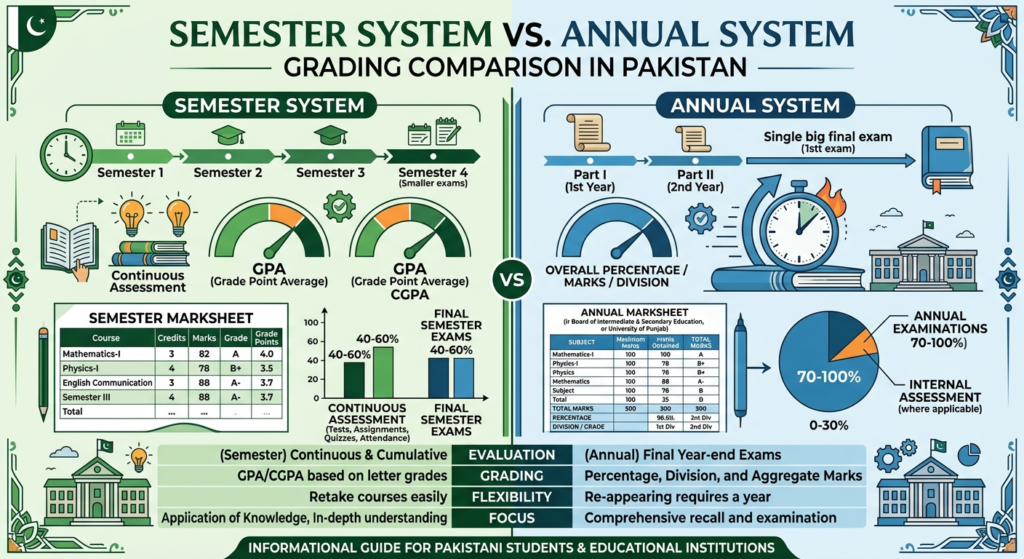
Semester vs Annual System: If you’ve ever compared your CGPA to a friend’s “1st Division” and wondered how the two even relate, you’ve run into Pakistan’s two parallel grading systems. Most universities today use the semester system, but the annual system hasn’t disappeared — some degree programs, boards, and affiliated colleges still use it. Understanding the Semester vs Annual System can help you know which grading method applies to your result.
The Core Difference Between Semester vs Annual System
The semester system breaks a degree into short terms — usually 4 to 6 months each — with exams, assignments, and quizzes contributing to a grade at the end of every term. Your performance is tracked as GPA per semester and CGPA across your whole degree.
The annual system evaluates a full year of study in one exam sitting, with a single result expressed as a percentage and a “Division” — a category that determines how strong that percentage is considered.
Neither system is inherently better — they’re just structured differently, and Pakistan has been transitioning from annual to semester at the university level for years without fully retiring either one.
Where Each System Is Actually Used
- Semester system: the near-universal standard at Pakistani universities for bachelor’s, master’s, and PhD programs, especially since HEC’s push for uniform semester-based assessment.
- Annual system: still standard for Matric (9th–10th) and Intermediate (11th–12th) board exams, and it persists in some two-year bachelor’s programs (like B.A. or B.Com) and a handful of affiliated colleges that haven’t fully transitioned.
If your result slip shows a percentage and a “Division” rather than a GPA, you’re almost certainly on the annual system — not a mistake, just a different track.
Semester vs Annual System: How Grading Actually Compares
| Semester System | Annual System | |
|---|---|---|
| Result format | GPA (per term) + CGPA (overall) | Percentage + Division |
| Grading scale | 0.0–4.0 | 0–100% |
| Assessment timing | Every 4–6 months | Once per year |
| Passing threshold | Typically 50% (grade D) | 33% |
| Top category | CGPA 3.5+ (Dean’s List range) | 1st Division: 60%+ |
| Middle category | CGPA 2.5–3.49 | 2nd Division: 45%–59.9% |
| Lower passing category | CGPA 2.0–2.49 | 3rd Division: 33%–44.9% |
A rough (not official) equivalence some institutions use: a CGPA of 3.0+ is treated similarly to a 1st Division, and CGPA 2.0–2.99 similarly to a 2nd Division — but this varies by institution and isn’t a fixed HEC conversion, so don’t rely on it for anything formal without checking the specific requirement first.
Converting Between the Semester vs Annual System
There’s no single official nationwide formula that converts a Division into an exact CGPA, or vice versa — because the two systems measure fundamentally different things (a whole year of exams vs. a running average across many smaller assessments). What you can reliably convert is CGPA to percentage using HEC’s standard formula:
Percentage = CGPA × 25
This is useful for scholarship forms, job applications, and foreign university admissions that ask for a percentage instead of a CGPA. Try our CGPA to Percentage Converter for an instant result.
If you’re on the annual system and need a CGPA-equivalent figure for a semester-based application, the honest answer is: there usually isn’t a clean official conversion, and the receiving institution or scholarship body will typically ask for your actual percentage and Division rather than force a translation. When in doubt, provide the annual system figures as-is rather than guessing an equivalent CGPA.
Semester vs Annual System: Which Is “Harder”?
Neither is objectively harder — they just distribute risk differently:
- Semester system: one bad exam only affects one course in one term, and you can often recover your CGPA over several following semesters. But it demands consistent effort year-round, since assignments and quizzes count throughout.
- Annual system: your entire year rides on a single exam sitting, which is higher-stakes but means you’re only tested once, with no ongoing quizzes or assignment pressure diluting your final grade.
Students who prefer steady, incremental work tend to do better under semester grading; students who prefer concentrated exam-season study sometimes find the annual system more predictable.
Frequently Asked Questions
Can a university use both the semester and annual systems at the same time?
The Semester vs Annual System can vary within the same university depending on the programs while its affiliated colleges (offering older two-year degree programs) still use the annual system. Always check which one applies to your specific program, not just your university’s name.
Is CGPA 3.0 the same as 1st Division?
Not officially — there’s no fixed nationwide conversion between the two. Some institutions informally treat CGPA 3.0+ as roughly equivalent to 1st Division for internal purposes, but for anything formal (scholarships, job eligibility), provide the actual figure from your own system rather than assuming an equivalence.
Why did Pakistan move toward the semester system?
HEC introduced uniform semester-system guidelines to standardize how universities assess students nationally, aiming for more consistent, transparent, and continuously-assessed evaluation compared to a single high-stakes annual exam.
I’m on the annual system — can I still use a CGPA calculator?
I’m on the annual system — can I still use a CGPA calculator? A CGPA calculator is built for semester-system credit-hour-based grading, so it won’t apply directly to an annual-system percentage result. If your result slip shows a percentage and Division rather than a GPA, use a percentage/division calculator instead.