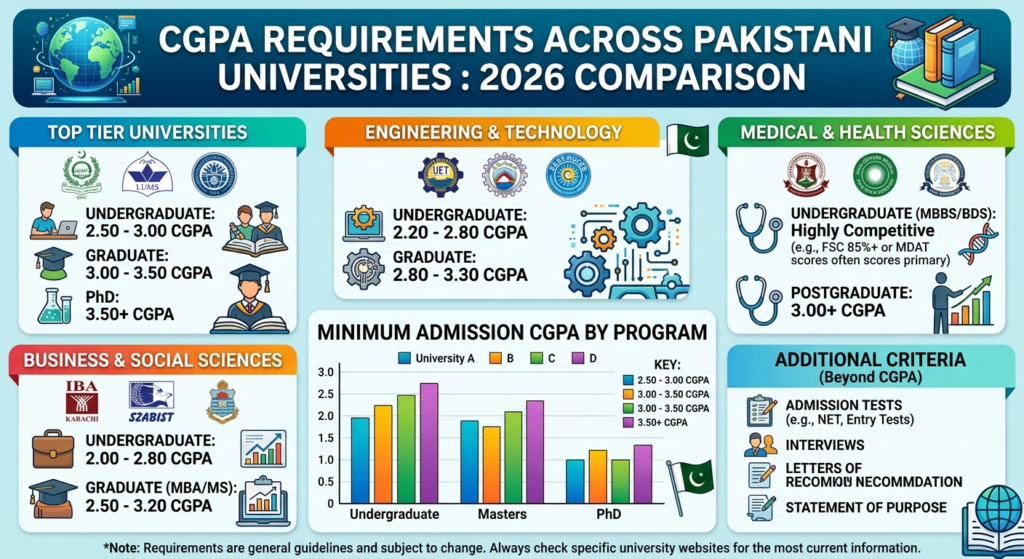
CGPA requirements across Pakistani universities vary more than most students realize, and almost no one publishes them side by side. If you have ever wondered whether NUST’s 2.0 probation threshold is typical, or whether COMSATS’ Dean’s List cutoff is unusually high, there is no single place that answers that – until now. This page compiles what we have verified directly against official sources, and is honest about what we have not yet confirmed for every institution.
CGPA Requirements Across Pakistani Universities: Full Comparison Table
| University | Grading Method | Probation Threshold | Graduation Minimum | Dean’s List | Confirmed? |
|---|---|---|---|---|---|
| COMSATS | Credit-weighted, fixed scale | 2.00 CGPA | 2.00 CGPA | 3.50 semester GPA | Yes |
| NUST | Credit-weighted, relative (curved) | 2.00 CGPA | 2.00 CGPA (undergrad) | 3.50 semester GPA | Yes |
| PU | Credit-weighted, fixed scale (semester programs) | Not independently confirmed | Not independently confirmed | Not independently confirmed | Not yet |
| UAF | Credit-weighted, fixed scale | Not independently confirmed | Not independently confirmed | Not independently confirmed | Not yet |
| LUMS | Credit-weighted, fixed scale | Not independently confirmed | Not independently confirmed | Not independently confirmed | Not yet |
| FAST-NUCES | Credit-weighted, fixed scale | Not independently confirmed | Not independently confirmed | Not independently confirmed | Not yet |
Confirmed means we verified the specific number against an official university source, not just the general HEC 4.0 scale every institution nominally follows. Where a cell says not independently confirmed, that university still uses the standard HEC scale – we simply have not verified a specific policy number beyond it. See our open reference data on GitHub for the full sourcing on each entry.
What This Data Actually Shows
The two universities we have fully verified – COMSATS and NUST – share an identical 2.00 CGPA probation threshold and an identical 3.50 semester GPA Dean’s List cutoff, despite being very different institutions. That is a useful data point on its own: a 2.0 CGPA at either school puts you in the same academic-standing category.
The more interesting difference is grading method, not thresholds. NUST uses relative (curved) grading, where your letter grade depends partly on how your cohort performed, not just your raw score. COMSATS uses a fixed scale, where a given percentage always maps to the same letter grade regardless of the class average. This changes what improving your CGPA actually means at each institution.
Why We Are Not Filling In the Rest With Guesses
It would be easy to assume PU, UAF, LUMS, and FAST-NUCES use the same pattern as COMSATS and NUST, since all four follow the same general HEC 4.0 scale. We are not going to publish that as fact without checking it directly against each university’s own regulations first. If you are a current student at any of these four and can point us to your official academic policy document, let us know through our contact page – we will verify it and update both this page and our open dataset with proper attribution.
How This Connects to Your Own Calculations
Knowing your university’s specific thresholds is only half the picture – the other half is knowing where you actually stand. Use our CGPA Calculator to get your current number, then our Target GPA Calculator to see exactly what you need this semester to clear your specific university’s threshold from the table above. If you’re on the borderline of a probation threshold, our CGPA Predictor can also project where you’ll land by graduation if your current trend continues, which is often more useful than a single semester’s target.
Why Grading Policy Consistency Matters for Transfer Students
If you’re transferring between Pakistani universities, or applying to a graduate program at a different institution than your undergraduate degree, these threshold differences become directly relevant. A 2.0 CGPA that kept you off probation at one university might read differently to an admissions committee evaluating you against a different school’s typical standards, even though both operate under Pakistan’s Higher Education Commission (HEC) framework. This is exactly the kind of nuance a single generic “good CGPA” number can’t capture, and why we’re building this comparison out university by university rather than publishing one-size-fits-all advice.
Frequently Asked Questions
Where do I find my total required credit hours for a Pakistani university?
Check your degree program’s official curriculum sheet from your university, usually available from your department or student portal.
Why is COMSATS and NUST data confirmed but PU, UAF, LUMS, and FAST-NUCES marked as not yet confirmed?
COMSATS and NUST thresholds were independently verified against official sources. The other four universities use the standard HEC 4.0 scale, but their specific probation and graduation thresholds have not yet been independently confirmed, so they are marked honestly rather than guessed.
What CGPA counts as good across Pakistani universities?
On the HEC 4.0 scale generally, 3.5 or higher is considered excellent, 3.0 to 3.49 is very good, and most universities require at least 2.0 to avoid academic probation, though exact thresholds vary by institution.
Related University Guides
- COMSATS CGPA Calculator
- NUST CGPA Calculator
- PU CGPA Calculator
- UAF CGPA Calculator
- LUMS CGPA Calculator
- FAST NUCES CGPA Calculator
- Scholarship Eligibility Checker