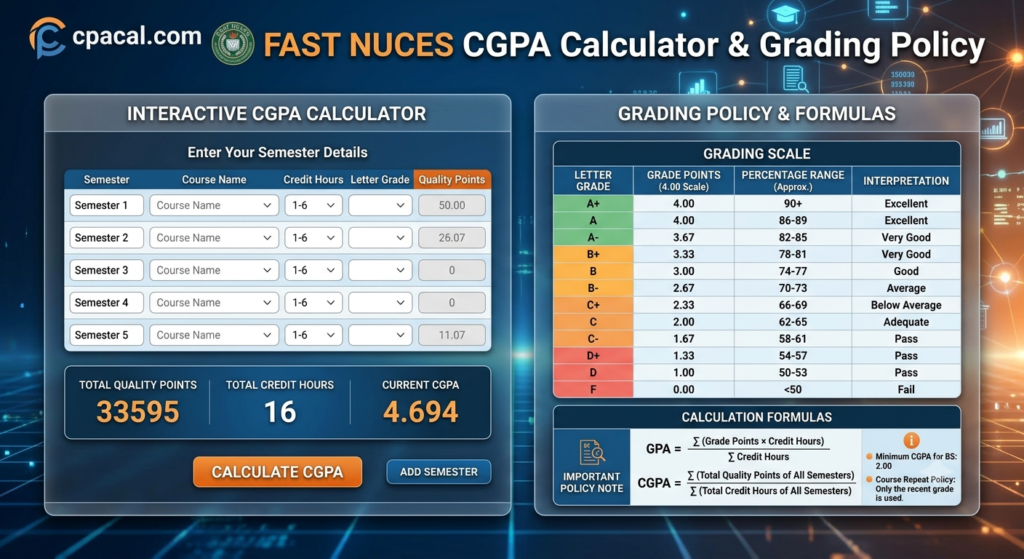
Using a FAST NUCES CGPA calculator without understanding the rules behind it is risky. If you’re a FAST-NUCES student — Islamabad, Karachi, Lahore, Peshawar, Chiniot-Faisalabad, or Multan campus — your CGPA controls more than your transcript. It decides whether you get an academic warning, whether you can register for next semester without special approval, and eventually whether you graduate at all. FAST runs one of the strictest retention policies of any university in Pakistan, so knowing exactly how the numbers work isn’t optional.
This guide covers the official FAST NUCES grading scale (both Absolute and Relative), the SGPA and CGPA formulas the university actually uses, the academic warning system, and how to convert CGPA to a percentage. Whether you’re using a FAST GPA calculator for a single semester or tracking your full NUCES CGPA calculator history across your degree, the same official rules apply.
FAST NUCES CGPA Calculator: Grading Scale, Absolute vs. Relative
Every course at FAST is graded under one of two schemes, and your instructor is required to announce which one applies at the start of the semester.
Absolute Grading maps your final percentage directly to a fixed grade, no matter how the rest of the class performs:
| Total Marks (%) | Grade |
|---|---|
| 90 and above | A+ |
| 86 – 89 | A |
| 82 – 85 | A- |
| 78 – 81 | B+ |
| 74 – 77 | B |
| 70 – 73 | B- |
| 66 – 69 | C+ |
| 62 – 65 | C |
| 58 – 61 | C- |
| 54 – 57 | D+ |
| 50 – 53 | D |
| 49 and below | F |
Relative Grading (the scheme most core computing and engineering courses use) grades you against the class average instead of a fixed cutoff:
- If the class average is below 50%, a C+ becomes the average grade.
- If the class average is between 50% and 64%, a B- becomes the average grade.
- If the class average is 65% or higher, a B becomes the average grade.
- Each grade band spans roughly 5 percentage points around that average, except the extremes — 90%+ always guarantees an A+, and 50%+ always guarantees at least a passing grade.
- Standard deviation isn’t used in this scheme, since marks distributions in a course are rarely a clean bell curve. Instead, FAST calculates a Modified Class Average (MCA) — the class average recalculated after removing statistical outliers — and grades are plotted around that.
Either way, in most undergraduate courses your semester score is built from 50% sessional work (quizzes, assignments, midterm) and 50% final exam, so consistent performance throughout the term matters as much as the final.
Fixed Grade Points (Both Schemes)
Once your letter grade is assigned — through either Absolute or Relative grading — it converts to a fixed grade point on the same 4.00 scale for GPA and CGPA purposes:
| Grade | Grade Points |
|---|---|
| A+ | 4.00 |
| A | 4.00 |
| A- | 3.67 |
| B+ | 3.33 |
| B | 3.00 |
| B- | 2.67 |
| C+ | 2.33 |
| C | 2.00 |
| C- | 1.67 |
| D+ | 1.33 |
| D | 1.00 |
| F | 0.00 |
MBA/MS programs treat C (2.00) as the lowest passing grade, and PhD coursework treats B- (2.67) as the lowest passing grade.
Three grades carry no grade points and are excluded from both SGPA and CGPA entirely: W (Withdrawn), I (Incomplete — auto-converts to F if not resolved by the end of the next semester), and CR (Continuing Research, PhD only).
How FAST Calculates SGPA
Semester GPA is a credit-hour-weighted average, not a simple average of your grades. A 4-credit major course pulls four times harder on your GPA than a 1-credit lab. This is exactly the logic every FAST NUCES CGPA calculator runs behind the scenes.
SGPA = Σ (Grade Points × Credit Hours) ÷ Σ Credit Hours
Example — a Computing student’s semester:
| Course | Credit Hours | Grade | Grade Points | Quality Points |
|---|---|---|---|---|
| Programming Fundamentals | 4 | B+ | 3.33 | 13.32 |
| Calculus | 3 | A- | 3.67 | 11.01 |
| English | 3 | A | 4.00 | 12.00 |
| Programming Lab | 1 | A | 4.00 | 4.00 |
Total credit hours = 11. Total quality points = 40.33. SGPA = 40.33 ÷ 11 = 3.67
That 3.67 also happens to clear the bar for the Dean’s List, which FAST awards to students who hit a 3.67 or higher semester GPA.
How FAST Calculates CGPA
CGPA extends the same weighted formula across every semester you’ve completed: A reliable FAST NUCES CGPA calculator applies this same formula automatically across every semester.
CGPA = Σ (SGPA × Semester Credit Hours) ÷ Σ Total Credit Hours Completed
The detail that trips students up: repeated courses. If you retake a course, only your newest grade counts toward CGPA — even if your first attempt was somehow higher. The old grade stays visible on your transcript with a repeat marker, but it’s dropped from the calculation. This is also the fastest lever for recovering a damaged CGPA: retaking a D or F and pulling it up to a B or A replaces the old value completely rather than averaging with it.
Rather than tracking this by hand across six or eight semesters, you can plug your semester GPAs and credit hours into a free FAST CGPA calculator and get an instant, accurate cumulative result — including proper handling of repeated courses.
FAST NUCES Academic Warning & Probation Policy
This is the part most students underestimate. FAST doesn’t just flag a low CGPA once — it counts warnings semester by semester, and cancels admission automatically once you hit the limit. Checking this every semester with a FAST NUCES CGPA calculator is the easiest way to catch a slide before it becomes a warning.
| Program | Minimum CGPA to Avoid Warning |
|---|---|
| BS / BBA | 2.00 |
| MBA / MS | 2.50 |
| PhD | 3.00 |
Here’s how the count works:
- At the end of every semester — including your first semester and summer sessions — if your CGPA falls below the minimum for your program, your warning count goes up by one.
- Once you’re on warning, you can’t register for the next semester without sign-off from your Head of Department.
- If your CGPA climbs back to or above the minimum in a later semester, your warning count resets to zero.
- Three consecutive academic warnings and your admission is cancelled automatically. There’s no appeal built into the count itself.
If you’re on warning, FAST also requires you to repeat any passed course where your grade fell below your program’s minimum CGPA threshold. For an MS student on warning, that means repeating anything graded C or C-, even though those are technically passing grades.
FAST CGPA to Percentage Conversion
FAST-NUCES doesn’t publish one official CGPA-to-percentage formula, but the HEC-standard conversion used across Pakistani universities is:
Percentage = (CGPA ÷ 4.00) × 100
So a 3.50 CGPA converts to roughly 87.5%, and a 3.00 CGPA converts to roughly 75%. Scholarship applications, job portals, and foreign university applications that ask for a percentage will generally accept this HEC-standard conversion — but if you’re applying somewhere formal, ask whether they want your official transcript percentage instead (available from your Head of Department’s office) rather than the converted estimate. Our FAST NUCES CGPA calculator shows both the raw CGPA and this converted percentage side by side.
How FAST-NUCES Compares to COMSATS Grading
Both FAST and COMSATS run a 4.00-scale, credit-hour-weighted CGPA system under HEC guidelines, but the warning thresholds and consequences differ. FAST cancels admission after three consecutive warnings; COMSATS runs its own separate probation cycle with different reinstatement rules. If you’re comparing offers or transferring between the two, check our COMSATS CGPA Calculator & Grading Policy guide for the side-by-side rules before you decide.
Frequently Asked Questions
What CGPA do I need to avoid a warning at FAST? 2.00 for BS/BBA, 2.50 for MBA/MS, and 3.00 for PhD, checked at the end of every semester including summer.
Does FAST NUCES use absolute or relative grading? Both — it depends on the instructor and the course. Instructors must announce which scheme they’re using at the start of the semester in the course outline. Most core computing and engineering courses lean relative; labs and some intro courses tend to use absolute.
What happens if I get an F? The course must be repeated. Only your new grade counts toward CGPA once you retake it.
Can I graduate with a CGPA below 2.00? No. A minimum CGPA of 2.00 is required for the BS/BBA degree to be awarded, on top of clearing all program credit-hour requirements.
Is the grading policy the same across all FAST campuses? Yes — Islamabad, Karachi, Lahore, Peshawar, Chiniot-Faisalabad, and Multan all follow the same university-wide grading and warning policy.
What CGPA counts as “good” at FAST? A CGPA above 3.00 is generally considered good, and 3.5 or higher typically qualifies for the Dean’s List and graduation with distinction. Anything in the 2.5–3.0 range is average but acceptable for most job placements.
Track Your CGPA the Easy Way
Manually recalculating your CGPA every time you get a new grade is where most students lose track of where they actually stand. Use our free CGPA Calculator to get your cumulative GPA instantly, or try the Target GPA Calculator to work out exactly what grades you need next semester to stay off warning or hit the Dean’s List.
Related University Calculators & Tools
- PU CGPA Calculator
- UAF CGPA Calculator
- COMSATS CGPA Calculator
- NUST CGPA Calculator
- LUMS CGPA Calculator
- CGPA Predictor — project your final graduating CGPA
- Credit Hour Calculator — see how many credit hours and semesters you have left
- Scholarship Eligibility Checker
- Grade Calculator — combine quizzes, midterm, and final into one course grade
- Study Planner — build a realistic daily study schedule
- CGPA Requirements Across Pakistani Universities – compare probation, graduation, and Dean’s List thresholds
This guide reflects FAST-NUCES’s published grading policy (effective Spring 2020 onward) and the official grading page at nu.edu.pk/Student/Grading. Always confirm against your current Student Handbook or SLATE portal, as policies can be revised by the university.