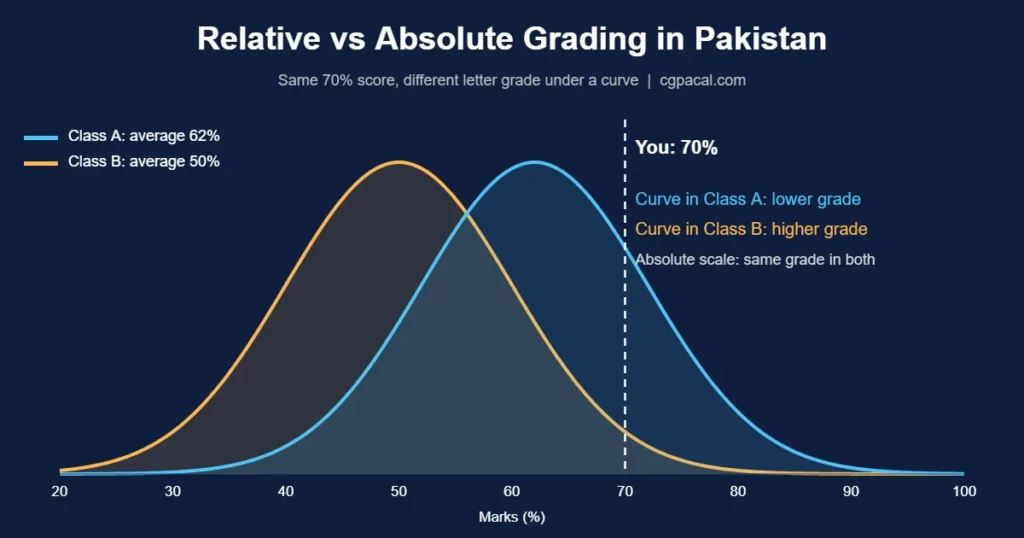
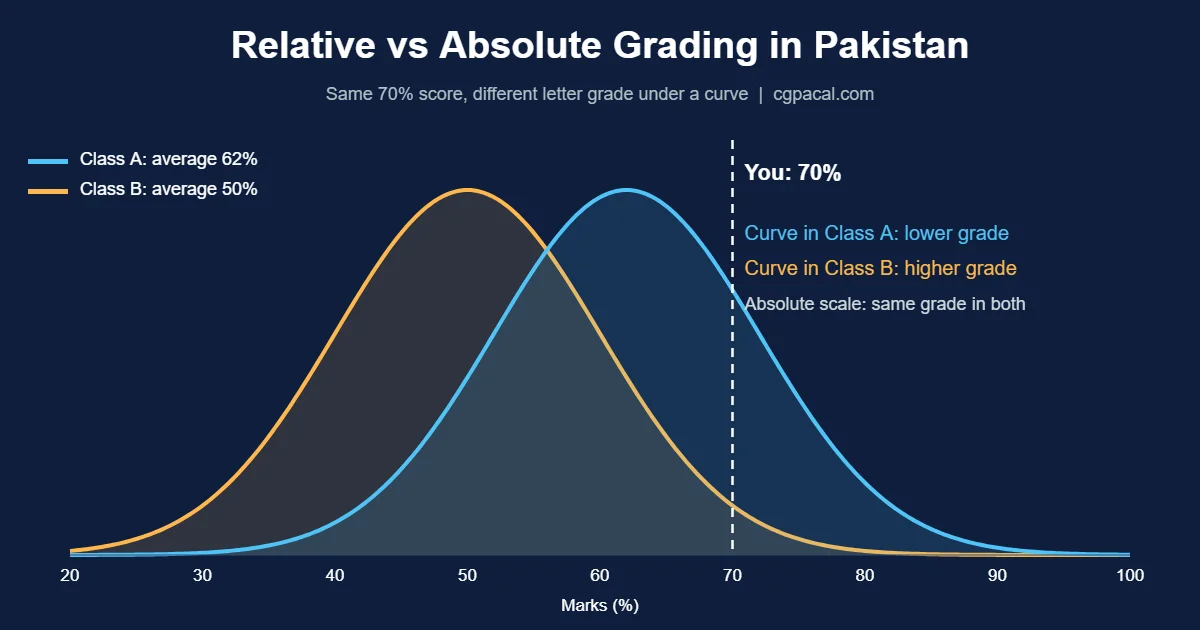
Relative grading in Pakistan means your letter grade depends on how you performed compared with the rest of your class, not only on the percentage you scored. Under a curve, 70% might be an A in a hard course where most people scored 50%, and only a B in an easy course where the average was 70%. Under absolute grading, 70% always lands on the same grade.
If you study at NUST, FAST, LUMS or most engineering and business schools, you have almost certainly been graded on a curve at least once. This guide explains how relative grading in Pakistan works, who uses it, what it does to your CGPA, and how to plan your semester around it.
What Is Relative Grading in Pakistan?
Relative grading in Pakistan (also called curved grading or grading on a curve) sets the grade cut-offs after the exam, using the whole class’s marks. The teacher or exam system first works out the class average and how spread out the marks are (the standard deviation). Grades are then given according to how far each student sits above or below that average.
Absolute grading, the main alternative to relative grading in Pakistan, works the other way round. The cut-offs are fixed before the semester starts, for example 85% and above is an A, and they never move. Your grade depends only on your own marks. Universities such as UAF use a fixed scale of this kind.
Relative vs Absolute Grading: The Key Differences
| Relative grading | Absolute grading | |
|---|---|---|
| Cut-offs set | After the exam, from class results | Before the semester, fixed |
| What decides your grade | Your position in the class | Your own percentage |
| Can you predict it early? | Only roughly | Yes, exactly |
| Strong class | Harder to get an A | No effect |
| Weak class | Easier to get a good grade | No effect |
| Typical use | Large theory courses | Labs, small classes, many public universities |
A Worked Example of a Grading Curve
Here is how a simple curve for relative grading in Pakistan can work. Say a class of 60 students has an average of 60% and a standard deviation of 10. A teacher using a mean-and-standard-deviation curve might set cut-offs like this. These numbers are an example only, not any university’s official rule.
| Grade | Rule (example) | Marks in this class |
|---|---|---|
| A | Average + 1.5 SD or more | 75% and above |
| A- | Average + 1 SD | 70–74% |
| B+ | Average + 0.5 SD | 65–69% |
| B | Around the average | 60–64% |
| B- | Average − 0.5 SD | 55–59% |
| C+ / C | Below average | 45–54% |
| D / F | Well below average or under the pass floor | Depends on university |
In this class, 70% earns an A-. Now imagine the same exam in a stronger section where the average is 70%. The same 70% now sits right at the average and earns a B. That is the core of relative grading in Pakistan: your grade travels with your class.
Most universities that use relative grading in Pakistan also keep safeguards. A common one is an absolute pass floor, so you cannot fail a course just because classmates did well. Some curves are applied only when the class is large enough for the statistics to mean anything.
Which Pakistani Universities Use Relative Grading?
There is no single national rule for relative grading in Pakistan. The Higher Education Commission (HEC) sets the semester-system framework, and each university writes its own examination regulations. Here is what we have confirmed from university documents and our own university guides:
- NUST: uses relative grading for its courses, so letter grades depend partly on cohort performance. See our NUST CGPA calculator and grading guide.
- FAST-NUCES: uses both schemes. The instructor announces at the start of the semester whether a course is graded absolutely or relatively. Details are in our FAST NUCES grading guide.
- LUMS: most courses, especially large core courses, are graded on a curve around a target average. See the LUMS grading guide.
- NUTECH Islamabad: its academic standards policy follows relative grading and recommends it for larger classes, with absolute grading for small ones.
- University of Sindh: its grading policy uses absolute grading by default, while encouraging teachers to adopt relative grading.
Many public universities, including UAF and Punjab University, publish fixed percentage scales instead. For a side-by-side view, see our CGPA requirements comparison across Pakistani universities. If your university is not listed here, or its handbook is unclear, check the grading section of your student handbook or the result shown in your LMS. Those are the final word.
How a Curve Affects Your GPA and CGPA
Under relative grading in Pakistan, the curve only decides the letter grade. Once you have it, the maths is the same everywhere: grade points × credit hours for each course, added up, divided by total credit hours. Our CGPA vs GPA guide explains the formula, and you can run your own numbers in the free CGPA calculator.
What changes is predictability. Under absolute grading, you can work out the exact grade from your marks before results. Under relative grading in Pakistan, you can only estimate until the cut-offs are published. That is why a grade calculator gives you a raw percentage, not a guaranteed letter, for curved courses.
How to Do Well When You Are Graded on a Curve
- Ask on day one whether relative grading applies. At FAST, for example, the instructor must announce it. Don’t assume.
- Track the class average, not just your score. Teachers often share quiz and midterm averages. Being one standard deviation above average is usually B+ or better.
- Don’t relax after an “easy” paper. If everyone found it easy, the curve shifts up. Small mistakes cost more in easy exams.
- Don’t panic after a hard paper. If the whole class struggled, a modest score can still be a good grade.
- Plan with a target, not a guess. Use the target GPA calculator to see what semester GPA you need, then aim to stay comfortably above the class average in your heaviest credit-hour courses.
Converting a Curved CGPA to Percentage
Because relative grading in Pakistan does not tie grades to fixed percentages, converting them back is never exact. Use the formula your university prints on its transcript if there is one. Otherwise, the common HEC-style approximation is CGPA × 25, which our CGPA to percentage calculator uses. For job applications, scholarships or foreign admissions, request an official equivalence letter from your exam department rather than relying on a self-calculated figure.
FAQs About Relative Grading in Pakistan
Does HEC make relative grading compulsory in Pakistan?
No. HEC’s semester-system guidelines set the overall framework, but each university decides whether a course is graded on a fixed scale or on a curve. Some use absolute grading by default and let teachers apply a curve; others, mostly engineering and business schools, use relative grading for large theory courses.
Can I work out my exact grade before the result under relative grading?
Not exactly, because the cut-offs depend on the class average and spread, which you only learn after everyone’s marks are in. You can make a rough estimate: if you are clearly above the class average you are usually in the B+ to A range, and if you are near the average you are usually around B.
Does relative grading change how my CGPA is calculated?
No. The curve only decides which letter grade you get in each course. After that, your GPA and CGPA are calculated with the normal formula: grade points multiplied by credit hours, added up, then divided by total credit hours.
Is relative grading unfair to good students?
It can be in a very strong class, because a high raw score may still sit near the class average and earn a middle grade. In a weak class the opposite happens and the same score can earn a higher grade. That is why many universities keep an absolute pass floor and limit curves to larger classes.
How do I convert a curved CGPA into a percentage?
Use your university’s own conversion formula if it is printed on your transcript or result card. If not, the common HEC-style approximation is CGPA multiplied by 25, but for jobs, scholarships or foreign admissions ask your exam department for an official equivalence letter.