Introduction
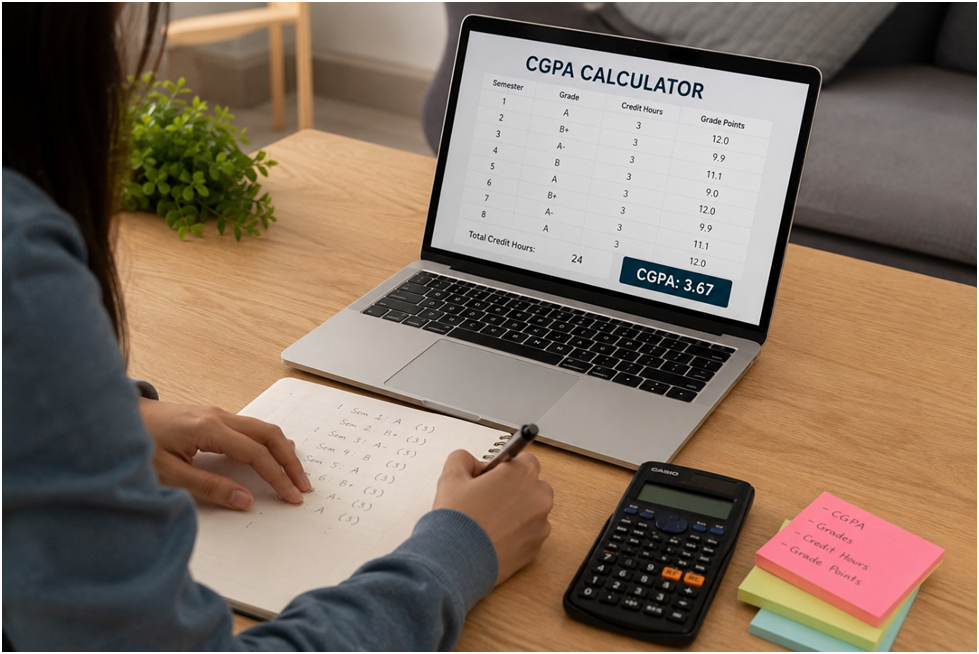
Our free CGPA Calculator helps students calculate their cumulative grade point average instantly without manual calculations.Whether you are a school student, college student, or university student, understanding your CGPA is important for tracking your progress, applying for scholarships, meeting graduation requirements, and preparing applications for higher education or employment.
Although many institutions use CGPA, the calculation method can vary between universities and countries. Some institutions calculate CGPA as a simple average of grade points, while others use a credit-hour weighted average. Always follow your institution’s official grading policy when calculating your final CGPA.
On CGPACal.com, you can use our CGPA Calculator to calculate your result instantly without performing manual calculations.
In this guide, you will learn:
- What a CGPA calculator is
- What CGPA means
- How CGPA is calculated
- The CGPA formula
- Simple calculation examples
- When to use a CGPA calculator
- Common grading terms every student should know
What Is a CGPA Calculator?
A CGPA calculator is an academic tool that calculates your overall Grade Point Average across multiple semesters or academic years.
Instead of calculating grades manually, you simply enter information such as:
- Grade obtained in each subject
- Grade points
- Credit hours (if required)
- Semester GPA (for some universities)
The calculator then applies the correct mathematical formula and provides your cumulative CGPA.
Because different educational institutions use different grading systems, a good CGPA calculator should allow students to calculate their results according to their university’s grading policy.
A CGPA Calculator Can Help You:
- Calculate your cumulative academic performance
- Combine multiple semesters into one overall CGPA
- Reduce calculation errors
- Save time
- Track academic progress
- Estimate future CGPA goals
- Prepare for scholarship and university applications
What Does CGPA Mean?
CGPA stands for Cumulative Grade Point Average.
It represents your overall academic performance throughout your educational program rather than your performance in just one semester.
Unlike SGPA (Semester Grade Point Average), which measures performance in a single semester, CGPA combines results from all completed semesters.
Simple Example
Imagine you are a student who completed four semesters with the following SGPAs:
- Semester 1 = 3.20
- Semester 2 = 3.45
- Semester 3 = 3.60
- Semester 4 = 3.80
If your university calculates CGPA by averaging semester GPAs, your estimated CGPA would be:
(3.20 + 3.45 + 3.60 + 3.80) ÷ 4 = 3.51
However, many universities use credit hours, so your official CGPA may be slightly different.
Your university may calculate your CGPA by averaging these values or by weighting them according to credit hours, depending on its grading policy.
This is why students should always verify how their institution calculates CGPA before using any calculator.
Difference Between CGPA and GPA
Many students think CGPA and GPA are the same, but they often represent different academic measurements.
| Feature | CGPA | GPA |
| Full Form | Cumulative Grade Point Average | Grade Point Average |
| Covers | Entire academic program | One semester, term, or academic period |
| Updates | After every semester | Every semester |
| Purpose | Shows overall academic performance | Shows performance during one grading period |
| Common Use | Universities and colleges | Schools, colleges, and universities |
Note: Some countries and universities use the terms GPA and CGPA interchangeably. Always refer to your institution’s official academic regulations.
Why Is a CGPA Calculator Important?
Knowing your CGPA is about more than just understanding your grades. It plays a significant role in many academic and professional opportunities.
1. Track Academic Progress
Your CGPA reflects how your performance changes over time. Monitoring it regularly helps you identify strengths and areas for improvement.
2. Scholarship Applications
Many scholarships include a minimum CGPA requirement. Calculating your CGPA accurately helps you determine whether you meet eligibility criteria before applying.
3. University Admissions
Students applying for undergraduate, postgraduate, or international programs are often asked to submit their CGPA or an equivalent academic score.
4. Graduation Eligibility
Some universities require students to achieve a minimum CGPA before they can graduate. Regularly checking your CGPA allows you to monitor your progress toward graduation requirements.
5. Internship Opportunities
Many internship programs use academic performance as one of their selection criteria. Maintaining a competitive CGPA can improve your chances of being shortlisted.
6. Employment Applications
Some employers request applicants’ academic records, including GPA or CGPA, particularly for entry-level positions and graduate trainee programs.
7. Higher Education Planning
Students preparing for master’s or doctoral programs often use their CGPA to evaluate admission requirements at different institutions.
Common Academic Terms You Should Know
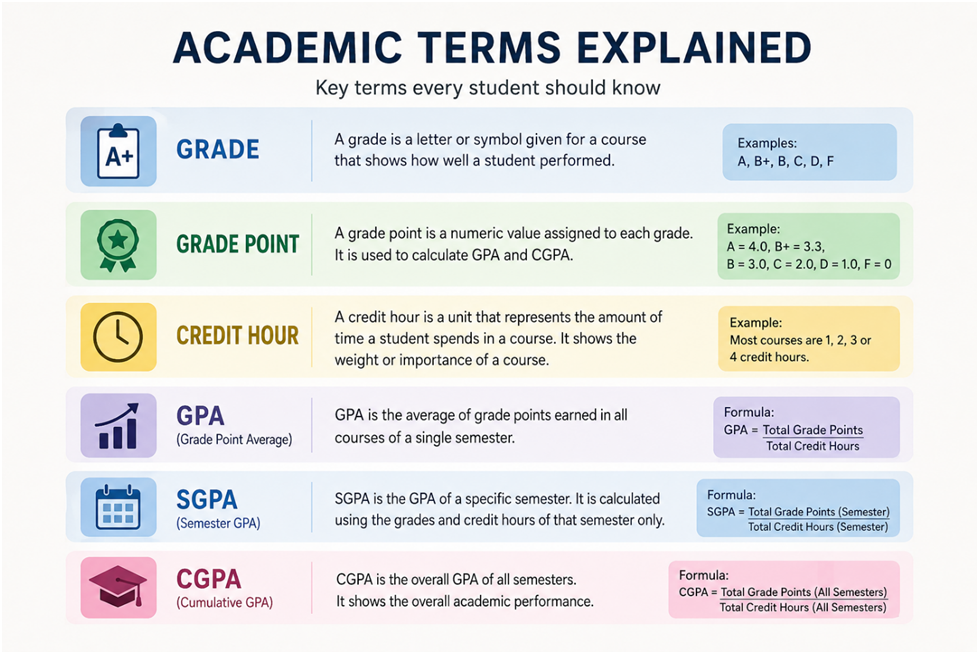
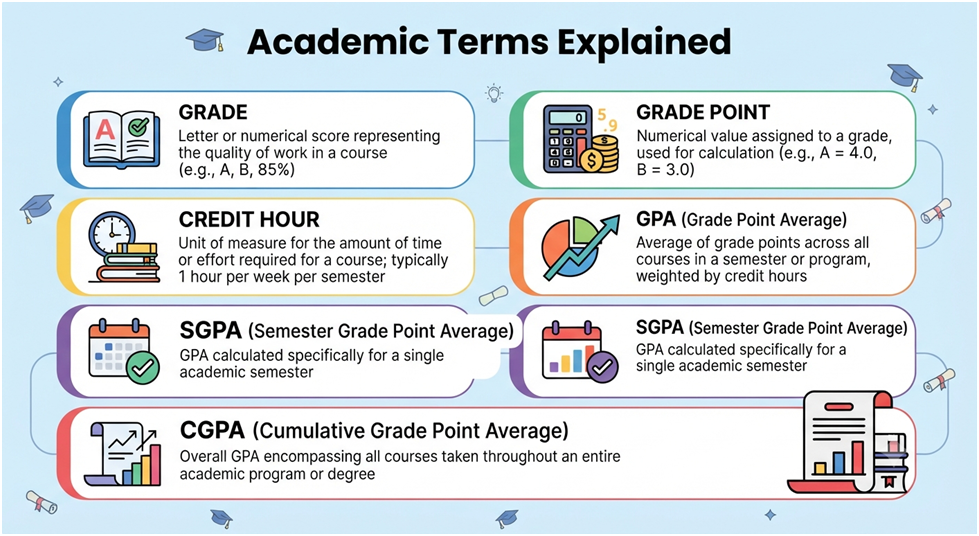
Before calculating your CGPA, it’s helpful to understand a few common academic terms.
| Term | Meaning |
| Grade | Letter or score earned in a course |
| Grade Point | Numerical value assigned to a grade |
| Credit Hour | Weight assigned to a course based on instructional hours |
| GPA | Grade Point Average for a semester or academic period |
| SGPA | Semester Grade Point Average |
| CGPA | Overall Grade Point Average across multiple semesters |
| Transcript | Official record of academic performance |
| Semester | One academic term within a program |
Understanding these terms makes it easier to follow the CGPA calculation process.
How Does a CGPA Calculator Work?
A CGPA calculator follows a mathematical process to determine your cumulative academic performance.
Although the exact formula differs among institutions, the calculation generally involves the following steps.
Step 1: Collect Your Grades
Gather your grades or grade points for each completed course or semester.
For example:
| Subject | Grade |
| Mathematics | A |
| Physics | B+ |
| Chemistry | A |
| English | A− |
Step 2: Convert Grades into Grade Points
Many institutions assign numerical values to letter grades.
A sample grading scale might look like this:
| Grade | Grade Point* |
| A | 4.00 |
| A− | 3.70 |
| B+ | 3.30 |
| B | 3.00 |
| C+ | 2.30 |
| C | 2.00 |
* Example only. Grade-point values vary by institution. Always use your university’s official grading scale.
Step 3: Include Credit Hours (If Required)
Many universities assign different weights to courses based on their credit hours.
For example:
| Course | Credit Hours |
| Mathematics | 4 |
| Physics | 3 |
| English | 2 |
| Programming | 4 |
Courses with more credit hours generally have a greater impact on your final CGPA in weighted grading systems.
Step 4: Apply the Appropriate Formula
The calculator applies your institution’s grading formula to determine your cumulative grade point average.
The final result represents your overall academic performance after considering all completed coursework.
CGPA Formula
There is no single universal CGPA formula because educational institutions use different grading systems.
However, the two most common methods are shown below.
Method 1: Credit-Hour Weighted Formula
Many universities calculate grades using the following weighted formula:
What Each Variable Means
| Variable | Description |
| Grade Points | Numerical value assigned to your grade |
| Credit Hours | Weight of each course |
| Σ | Total (sum) of all values |
When this formula is applied to all completed semesters, it calculates your CGPA.
When it is applied to only one semester, it calculates your GPA or SGPA, depending on your institution.
Method 2: Average of Semester GPAs
Some institutions calculate CGPA by averaging semester GPAs.
This approach only produces the same result as the credit-weighted formula if every semester carried identical credit hours — which is rarely true for a real degree. Treat this as a simplification, not the standard method: most universities officially use the credit-weighted formula above.
Always confirm which method your institution follows.
Worked Example: Calculating CGPA Using Credit Hours
The following example demonstrates how a weighted CGPA calculation works.
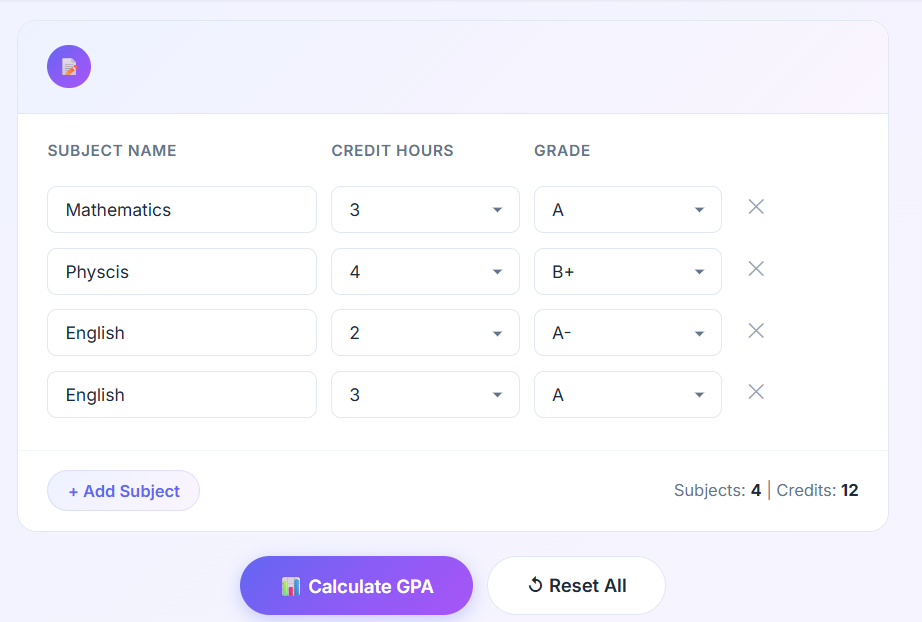
| Course | Grade Point | Credit Hours | Grade Point × Credit Hours |
| Mathematics | 4.00 | 3 | 12.00 |
| Physics | 3.30 | 4 | 13.20 |
| English | 3.70 | 2 | 7.40 |
| Programming | 4.00 | 3 | 12.00 |
| Total | — | 12 | 44.60 |
Input the above data into our CGPA Calculator:
Using the weighted formula:
If you enter these values into our CGPA Calculator, you’ll instantly get 3.72 without doing the math yourself.
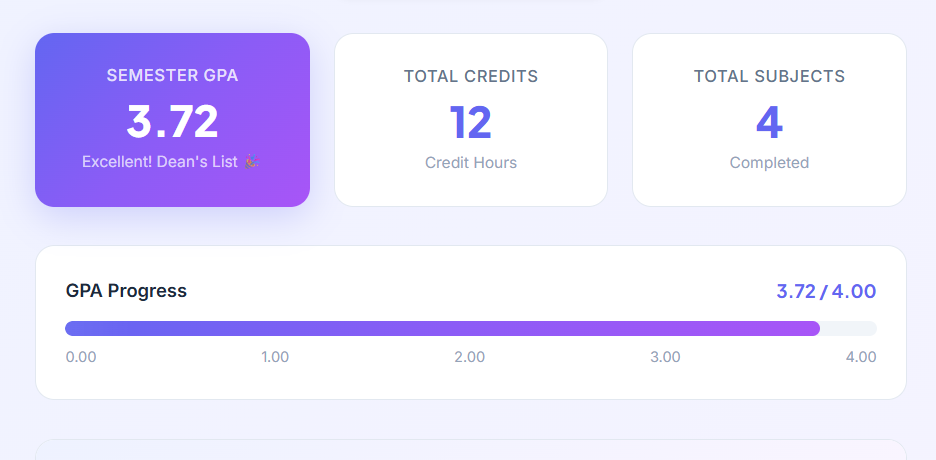
This example is for demonstration purposes only. Your actual result depends on your institution’s grading scale, credit-hour structure, and official calculation method.
When Should You Use a CGPA Calculator?
A CGPA calculator is useful in many academic situations, including:
- After completing a semester
- Before applying for scholarships
- While preparing university applications
- Before internship or job applications
- When planning future academic goals
- Before graduation to check eligibility
- To estimate the impact of future grades on your overall CGPA
Using a calculator regularly helps you monitor your academic progress and make informed decisions throughout your studies.
Calculate CGPA with Credit Hours
Many universities calculate CGPA using credit hours rather than taking a simple average of grades. This method gives more weight to courses that carry more credits because they usually require more classroom time, assignments, and assessments.
For example, a 4-credit engineering course has a greater impact on your CGPA than a 2-credit elective.
If your university uses a credit-based grading system, you should always include credit hours when calculating your CGPA.
Credit-Hour Weighted Formula
Most universities use the following formula:
CGPA = Σ (Grade Points × Credit Hours) ÷ Σ Credit Hours
Where:
- Grade Points = Numerical value assigned to your grade
- Credit Hours = Weight of the course
- Σ = Total (sum) of all values
This method ensures that courses with higher academic weight contribute more to your final CGPA.
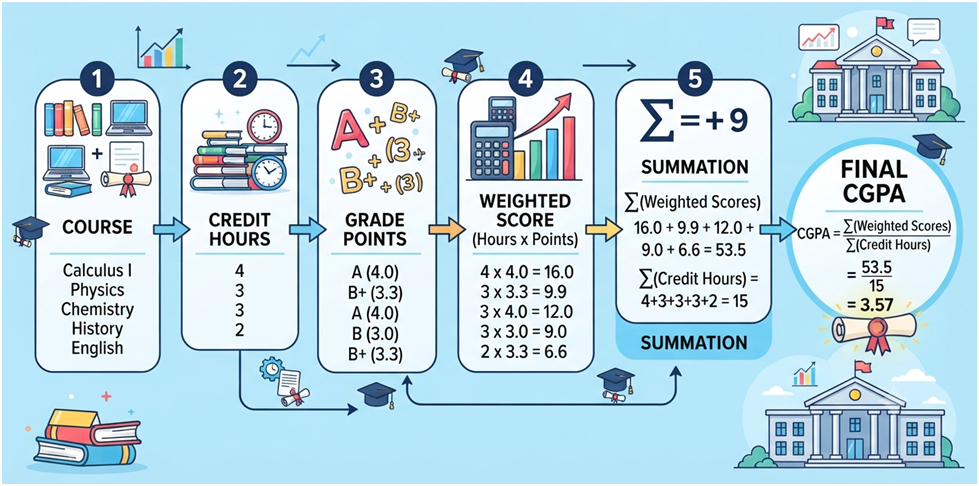
Step-by-Step Example
Suppose you completed five courses.
| Course | Grade | Grade Point* | Credit Hours | Grade Point × Credit Hours |
| Mathematics | A | 4.00 | 4 | 16.00 |
| Physics | B+ | 3.30 | 3 | 9.90 |
| Chemistry | A− | 3.70 | 3 | 11.10 |
| English | A | 4.00 | 2 | 8.00 |
| Computer Science | B | 3.00 | 4 | 12.00 |
| Total | — | — | 16 | 57.00 |
Now apply the formula:
CGPA = 57.00 ÷ 16 = 3.56
Final CGPA = 3.56
Important: The grade-point values above are examples only. Your institution may use a different grading scale.
Why Credit Hours Matter
Consider these two courses:
| Course | Credit Hours | Grade |
| Mathematics | 4 | A |
| History | 2 | C |
Even though History has a lower grade, Mathematics has a greater influence on the final CGPA because it carries more credit hours.
Ignoring credit hours can produce an incorrect CGPA.
What Is a Semester CGPA Calculator?
A semester CGPA calculator helps students estimate their cumulative CGPA after completing a new semester.
It combines your previous academic performance with your latest semester results to calculate your updated overall CGPA.
This is especially useful if you want to:
- Monitor your academic progress
- Predict your cumulative result
- Plan future semesters
- Determine how much improvement is needed to reach a target CGPA
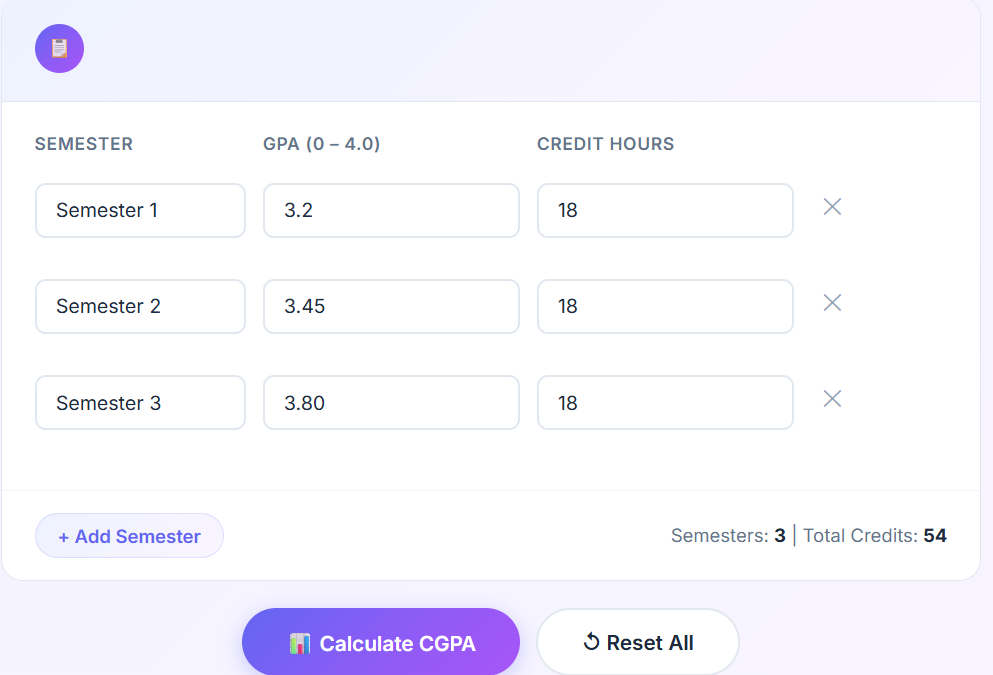
Example
Suppose:
| Semester | GPA |
| Semester 1 | 3.20 |
| Semester 2 | 3.45 |
| Semester 3 | 3.80 |
Input the required data in the Calculator:
Here’s the calculated result:
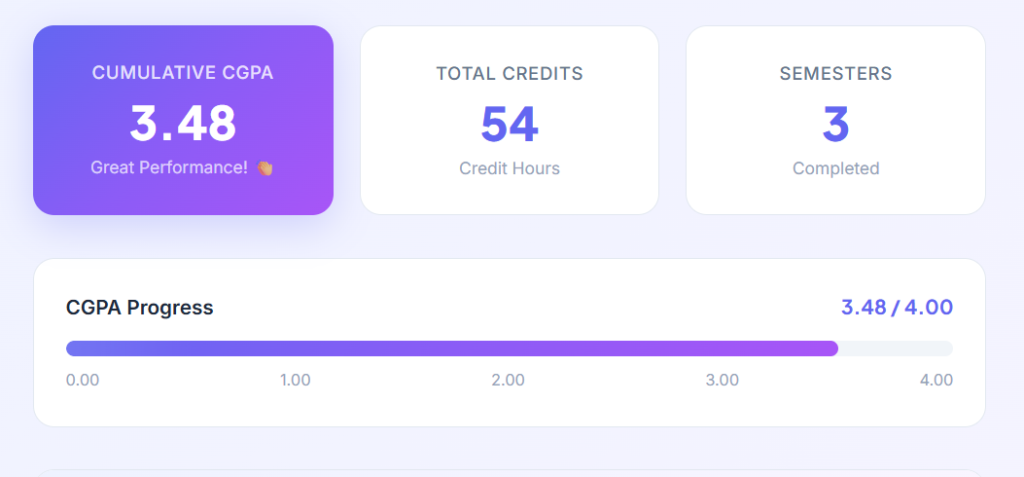
Depending on your university’s policy, your CGPA may be calculated:
- Using all semester GPAs equally, or
- Using the total grade points and credit hours from every completed course.
Always follow your institution’s official calculation method.
Related Conversions: SGPA and Percentage
Need to work with SGPA or percentage instead of CGPA? Rather than duplicate that math here, use these dedicated tools and guides, each covering one conversion in full depth:
- SGPA to CGPA Calculator — convert semester-by-semester SGPA into a cumulative CGPA
- CGPA to Percentage Calculator — convert your CGPA into a percentage using common scales
- CGPA vs GPA vs SGPA vs Percentage — a full side-by-side comparison of all four, including which one you actually need for a given situation
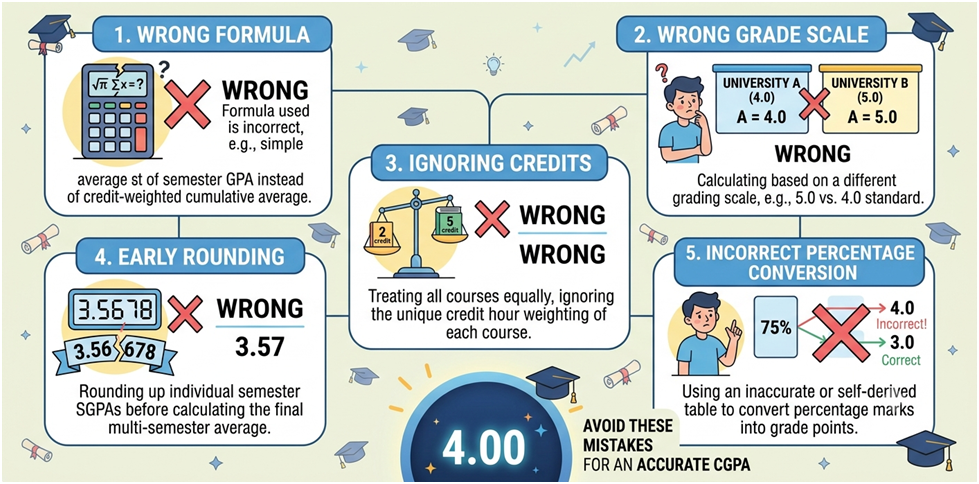
Common Mistakes When Calculating CGPA
Even small mistakes can lead to an incorrect CGPA.
Here are some of the most common errors.
1. Ignoring Credit Hours
Many students calculate a simple average even though their university uses weighted credit hours.
Always confirm your institution’s calculation method.
2. Using the Wrong Grade Scale
Not every university uses the same grade-point values.
Examples include:
- 4.0 scale
- 5.0 scale
- 10-point scale
- Institution-specific grading systems
Use only your university’s official grading scale.
3. Mixing GPA and CGPA
A semester GPA is not the same as your cumulative CGPA.
Keep these calculations separate unless your institution specifies otherwise.
4. Forgetting Repeated Courses
Some universities:
- Replace the old grade with the new grade.
- Average both attempts.
- Apply another official policy.
Always check your institution’s academic regulations.
5. Rounding Too Early
Avoid rounding intermediate values.
Round only the final CGPA if required by your institution.
6. Using an Unofficial Percentage Formula
Many websites promote a single CGPA-to-percentage formula.
In reality, conversion policies vary significantly between institutions.
Use only your university’s official conversion rules.
A Complete Student Case Study
Ali is a Computer Science student who scored this in the semester
Semester 1: 3.10
Semester 2: 3.35
Semester 3: 3.60
Semester 4: 3.80
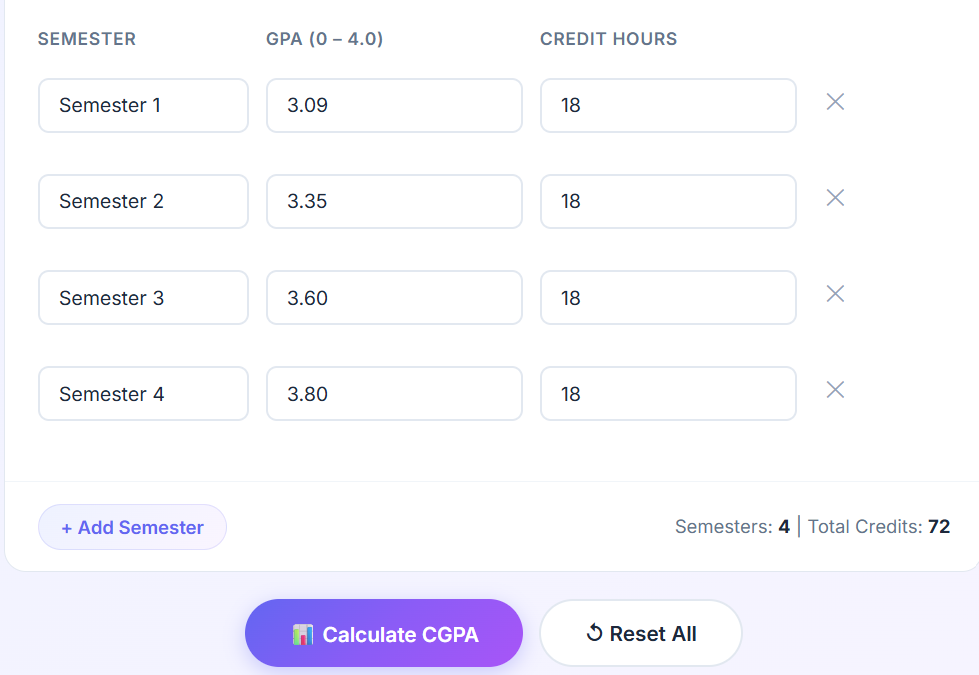
After entering these values into the CGPACal calculator, Ali’s estimated CGPA becomes:
3.46
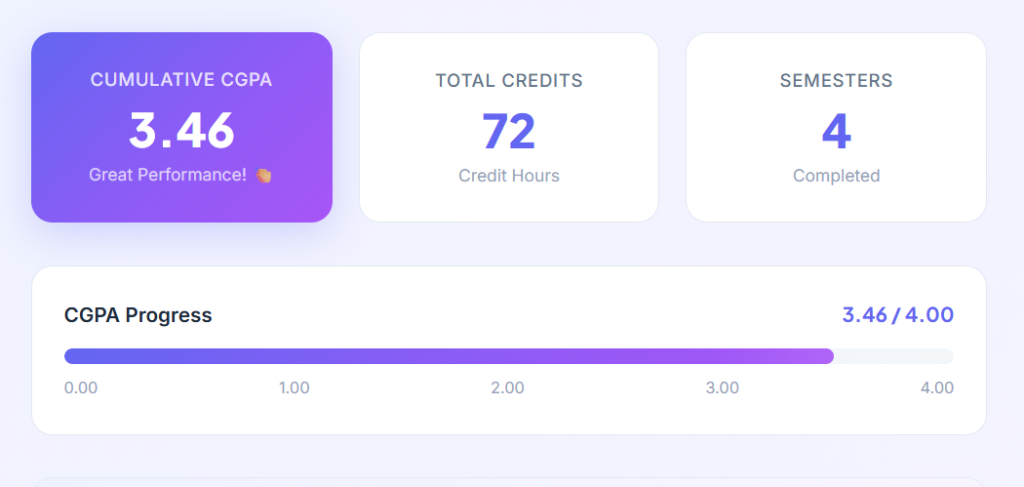
Ali now knows he needs approximately 3.90 in the next semester to reach a CGPA of 3.55.
Before You Calculate
✔ Collect all your grades.
✔ Check your university’s grading scale.
✔ Confirm your credit hours.
✔ Verify if your university uses GPA, SGPA, or CGPA.
✔ Keep your transcript ready.
Calculate Your CGPA in Under 30 Seconds
- 1. Open the CGPA Calculator.
- 2. Enter your grades.
- 3. Add credit hours.
- 4. Click Calculate.
- 5. Instantly view your CGPA.
Enter Grades > Add Credit Hours > Click Calculate > View CGPA
Practical Tips for Maintaining a Good CGPA
Improving your CGPA takes consistent effort rather than last-minute preparation.
Here are some practical strategies:
- Track your grades after every semester.
- Calculate your expected CGPA regularly.
- Give extra attention to high-credit courses.
- Seek help early if you are struggling in a subject.
- Review your university’s grading policy before making academic decisions.
- Plan your study schedule throughout the semester instead of relying on exam-week preparation.
- Keep copies of your transcripts and grade reports for future applications.
Using a CGPA calculator after each semester can help you understand how your latest results affect your cumulative academic performance.
Do All Universities Calculate CGPA the Same Way?
No.
One of the biggest misconceptions among students is that every university calculates CGPA using the same formula.
In reality, institutions may differ in several ways, including:
- Grade-point scale (for example, 4.0, 5.0, or 10-point systems)
- Credit-hour weighting
- Treatment of repeated courses
- Passing grade requirements
- Rules for incomplete or withdrawn courses
- Methods for converting CGPA to percentage
For this reason, always rely on your university’s:
- Academic regulations
- Official grading policy
- Student handbook
- Registrar’s office guidance
- Official transcript information
If you are applying to another institution or another country, verify whether they require CGPA, GPA, percentage, or another grading format.
Use Our CGPA Calculator
Instead of calculating everything manually, you can use the CGPACal.com CGPA Calculator to estimate your cumulative academic performance quickly and accurately.
It helps you:
- Calculate CGPA in seconds
- Reduce manual calculation errors
- Work with multiple semesters
- Include credit hours where required
- Monitor your academic progress throughout your studies
Who Can Use This Calculator?
This Calculator Is Useful For
- University students
- College students
- Engineering students
- Medical students
- International applicants
- Scholarship applicants
- Exchange students
Why Trust CGPACal?
- Educational content reviewed regularly.
- Formulas explained in beginner-friendly language.
- Supports multiple grading methods.
- Built for students.
- Updated whenever grading policies change.
- Encourages verification with official university regulations.
Frequently Asked Questions (FAQs)
1. What is a CGPA calculator?
A CGPA calculator is an online tool that helps you calculate your Cumulative Grade Point Average (CGPA) using your grades, grade points, and, where applicable, credit hours. It saves time and reduces the risk of manual calculation errors.
2. How is CGPA calculated?
The calculation method depends on your educational institution.
Many universities use this formula:
CGPA = Σ (Grade Points × Credit Hours) ÷ Σ Credit Hours
Some institutions instead calculate CGPA by averaging semester GPAs. Always check your university’s official grading policy.
3. Is CGPA the same as GPA?
Not always.
At many institutions:
- CGPA represents your overall academic performance across multiple semesters.
- GPA represents performance during a single semester or academic period.
However, some universities use these terms interchangeably. Always follow your institution’s terminology.
4. What is the difference between CGPA and SGPA?
SGPA (Semester Grade Point Average) measures your performance in one semester.
CGPA (Cumulative Grade Point Average) measures your performance across all completed semesters.
5. Do all universities calculate CGPA in the same way?
No.
Universities may differ in:
- Grade scales
- Credit-hour systems
- Treatment of repeated courses
- Passing requirements
- Rounding rules
- Percentage conversion methods
Always use your institution’s official grading policy.
6. What are credit hours?
Credit hours represent the academic weight of a course.
Courses with more credit hours usually contribute more to your final CGPA when a weighted calculation is used.
7. Can I calculate my CGPA without credit hours?
It depends on your university.
If your institution uses a simple average of grade points or semester GPAs, credit hours may not be required.
If it uses a weighted grading system, credit hours are essential.
8. Can I calculate CGPA for all semesters?
Yes.
A CGPA calculator is designed to combine your academic performance across all completed semesters.
9. Can I calculate my future CGPA?
Yes.
Many students use a CGPA calculator to estimate how future grades may affect their cumulative academic performance.
Remember that this is only an estimate until your official grades are released.
10. Is there one universal CGPA formula?
No.
Different universities use different grading systems.
There is no single formula that applies to every institution worldwide.
11. Is CGPA important for scholarships?
Yes.
Many scholarship providers require applicants to meet a minimum CGPA requirement.
Always review the official eligibility criteria for the scholarship you are applying for.
12. Does CGPA matter for jobs?
It can.
Some employers—particularly for graduate, internship, and entry-level positions—consider academic performance during recruitment.
Work experience, skills, and interviews are also important factors.
13. Can repeated courses affect my CGPA?
Yes.
Each university has its own policy regarding repeated courses.
Some replace the previous grade, while others include both attempts or apply another approved method.
14. How often should I calculate my CGPA?
It is a good practice to calculate your CGPA after each semester so you can monitor your academic progress and set realistic goals.
15. Is an online CGPA calculator accurate?
A CGPA calculator can provide accurate results when you enter the correct grades, credit hours, and grading scale.
The result is only as accurate as the information entered and should always follow your institution’s official calculation method.
Conclusion
A CGPA calculator is one of the most useful academic tools for students because it simplifies the process of calculating cumulative academic performance.
Whether you are preparing for your next semester, applying for scholarships, planning for graduation, or exploring Higher Education opportunities, understanding your CGPA helps you make informed academic decisions.
Keep in mind that there is no universal CGPA calculation method. Universities around the world use different grading scales, credit systems, and academic regulations. Before calculating or reporting your CGPA, always verify your institution’s official grading policy.
If you want a quick and reliable estimate of your academic performance, use the CGPACal.com CGPA Calculator. It helps you calculate your cumulative grade point average in seconds and supports students who need a simple, beginner-friendly way to monitor their academic progress.