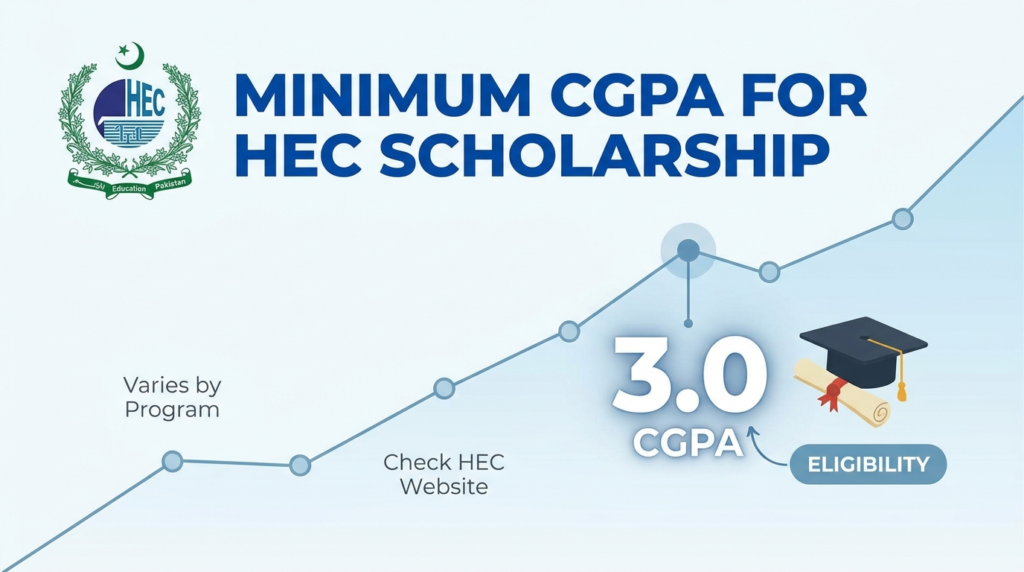
Ask five different people what the minimum CGPA for HEC scholarship eligibility actually is, and you’ll probably get five different answers — 3.0, 2.5, “as high as possible,” someone’s cousin who “just needed decent grades.” The truth is more specific than any of that, and it depends entirely on which scholarship you’re applying for, because HEC doesn’t run one program with one cutoff.
Here’s the actual minimum CGPA for HEC scholarship programs, broken down by degree level, plus the fine print that trips people up even when their CGPA clears the bar.
The Actual Minimum CGPA for HEC Scholarship Programs
For HEC’s overseas MS/MPhil scholarships, the published requirement is a minimum CGPA of 2.5 out of 4.0 (or roughly 60% marks) in your final degree. For PhD scholarships, the bar is higher — a minimum CGPA of 3.0 out of 4.0, or 75% marks, or first division under the annual system, in your MS/MPhil or equivalent degree.
Notice that’s already two different numbers for two different degree levels, and that’s before you factor in university-specific merit scholarships or need-based aid, which often set their own, separate criteria entirely.
| Scholarship Type | Minimum CGPA | Alternative (Marks/Division) |
|---|---|---|
| HEC Overseas MS/MPhil | 2.5 / 4.0 | ~60% marks |
| HEC Overseas PhD | 3.0 / 4.0 | 75% marks or First Division (annual system) |
Why This Number Isn’t the Same Everywhere
The 2.5 and 3.0 figures above are specifically for HEC’s overseas scholarship programs. Need-based scholarships, university-run merit scholarships, and Gold Medal criteria can all set different — sometimes stricter — thresholds, and they’re rarely all listed in one place. Rather than hunting through separate pages for each program, run your own numbers through our scholarship eligibility checker, which covers HEC need-based, merit, and postgraduate criteria in one tool.
The Fine Print Nobody Reads
This is where a lot of otherwise-qualified applicants get caught out. Clearing the minimum CGPA for HEC scholarship eligibility doesn’t automatically mean you’re in — there’s usually a second condition attached:
- Maximum one second division allowed throughout your entire academic career before the terminal degree — a strong CGPA doesn’t cancel out an earlier weak year on your transcript.
- HEC Aptitude Test (HAT) score — overseas scholarships typically require a minimum 70% on this separate test, regardless of your CGPA.
- Meeting the minimum is necessary, not sufficient — scholarships are awarded on a merit list, so a 2.5 CGPA that technically qualifies you may still lose out to applicants with a 3.4 competing for the same limited seats.
You can confirm the exact, current eligibility criteria for a specific scholarship cycle directly on HEC’s official scholarship eligibility page, since batch-to-batch details (age limits, test cutoffs) do shift occasionally.
Make Sure You’re Even Reading Your Own CGPA Correctly
This sounds almost too basic to mention, but it trips people up more than you’d think: before you compare your number against the minimum CGPA for HEC scholarship eligibility, double-check that you’re actually calculating your CGPA correctly in the first place. A surprising number of applicants misjudge their own eligibility because they averaged their semester GPAs directly instead of weighting by credit hours, which can shift the final number by a tenth of a point or more — sometimes the exact margin between qualifying and not. Our CGPA calculation guide walks through the credit-hour-weighted formula HEC actually uses, so you’re not applying — or deciding not to apply — based on a number that’s slightly off.
It’s also worth remembering that a merit list ranks every eligible applicant against each other, not against the cutoff itself. Two people can both clear the minimum CGPA for HEC scholarship eligibility and still get very different outcomes once the aptitude test scores and second-division count are factored in. The CGPA is your ticket to the room, not a seat at the table.
Sitting Just Below the Cutoff? Here’s What Actually Helps
If your CGPA is a few points under the minimum CGPA for HEC scholarship eligibility, you have more room to move than it might feel like right now. Use our target GPA calculator to see exactly what grades your remaining semesters need to clear the threshold. If a low grade from an earlier semester is the real drag on your average, our guide on CGPA after retaking a course explains when a repeat is actually worth the time. And if you’d rather work with what you have this semester, our CGPA improvement guide covers the levers that don’t involve waiting a full year.
Related: planning postgraduate study? Check the minimum CGPA for MS admission in Pakistan before you apply.
Frequently Asked Questions
What is the minimum CGPA for HEC scholarship eligibility?
It depends on the program. HEC overseas MS/MPhil scholarships typically require a minimum CGPA of 2.5 out of 4.0, while PhD scholarships require a minimum CGPA of 3.0 out of 4.0.
Does a 3.0 CGPA guarantee an HEC scholarship?
No. Meeting the minimum CGPA makes you eligible to apply, but scholarships are awarded competitively based on a merit list, aptitude test scores, and other criteria.
Is first division equivalent to the minimum CGPA requirement?
Yes, for PhD scholarships, HEC accepts first division under the annual system as an alternative to a 3.0 CGPA under the semester system.
Does one weak semester disqualify me even with a good final CGPA?
It can. Many HEC scholarships allow a maximum of one second division throughout your academic career, regardless of your overall final CGPA.
Do university merit scholarships use the same CGPA cutoff as HEC?
Not necessarily. University-specific merit and need-based scholarships often set their own separate CGPA thresholds, which may be higher or lower than HEC’s overseas scholarship criteria.
The Short Version
The minimum CGPA for HEC scholarship eligibility is 2.5 for MS/MPhil and 3.0 for PhD — but that’s the floor, not a guarantee, and it comes bundled with conditions on second divisions and aptitude test scores that catch people off guard. Check the current criteria for your specific program before you assume you’re either in or out.