You failed a course, or maybe just scraped a C in something that dragged your average down, and now you’re retaking it. Somewhere in the back of your mind is a question you haven’t actually gotten a straight answer to: does this new grade wipe out the old one, or are you stuck averaging the two forever? The honest answer is — it depends entirely on your university’s policy, and a lot of students find that out the hard way, usually right after their transcript comes out and their CGPA didn’t move nearly as much as they expected.
So let’s actually settle this. Here’s what happens to your CGPA after retaking a course, why the two most common policies produce wildly different results, and how to check which one applies to you before you spend a whole semester on a repeat that barely moves the needle.
What Actually Happens to Your CGPA After Retaking a Course
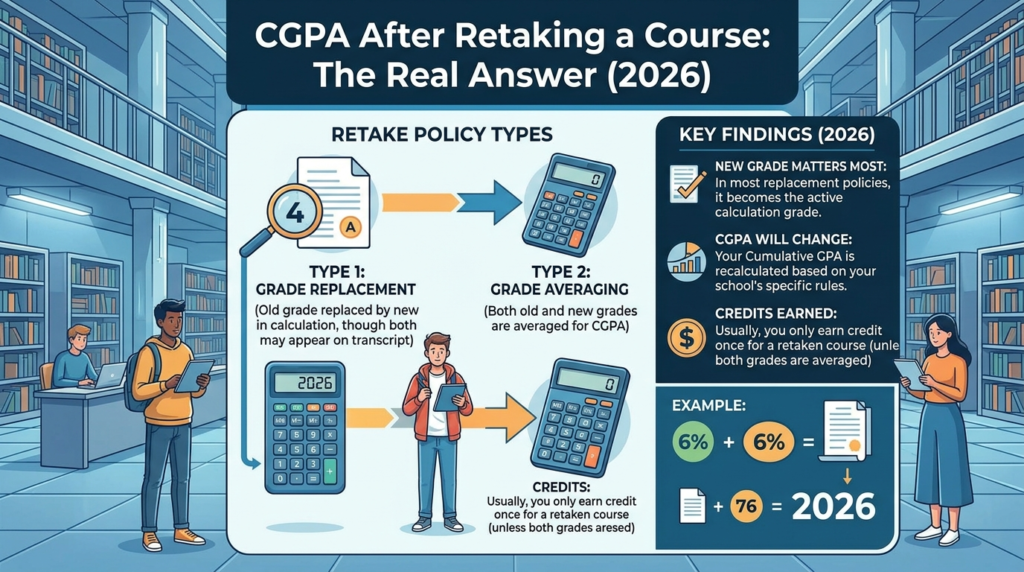
There are two policies in use across Pakistani universities, and they’re not interchangeable. One replaces the old grade entirely. The other keeps both attempts and averages them into your CGPA. Which one your university uses changes the math completely — and it’s usually buried in a section of the academic handbook nobody reads until they need it.
Grade Replacement: The Old Grade Disappears
Under a grade replacement policy, your new grade fully replaces the old one in your CGPA calculation — as if the failed or weak attempt never happened, at least mathematically. Your transcript will usually still show both attempts (often with a note like “R” for repeat), but only the better grade counts toward your CGPA.
This is the policy that makes retaking a course genuinely worth it. If you failed a 3-credit course the first time (grade point 0.0) and come back with a B+ (3.3), your CGPA jumps as if you’d earned that 3.3 from the start.
Grade Averaging: Both Attempts Count
Under grade averaging, both attempts stay in the calculation, and your CGPA reflects the combined credit hours and grade points of both. This is where a lot of students get blindsided — they retake a failed course, do well, and still see a smaller CGPA bump than they were expecting, because the old F is still dragging the number down alongside the new grade.
A Worked Example: Same Grades, Two Different Outcomes
Let’s make your CGPA after retaking a course concrete with real numbers. Say you failed a 3-credit course (0.0) and retook it with an A- (3.7). Here’s how the two policies treat that differently:
| Policy | Credit Hours Counted | Grade Points Counted | Resulting Average for This Course |
|---|---|---|---|
| Grade Replacement | 3 | 11.1 (3 × 3.7) | 3.70 |
| Grade Averaging | 6 | 11.1 (0 + 11.1) | 1.85 |
Same effort, same improved grade — and one policy gives you a 3.70 for that course while the other gives you 1.85. That’s not a rounding difference, that’s the entire reason you need to know which system you’re under before you decide a repeat is worth your time.
Checking Your CGPA After Retaking a Course: Which Policy Applies?
HEC doesn’t mandate one system across the board — it leaves grade replacement versus averaging up to each university’s own academic policy, within its Undergraduate Education Policy framework. That means NUST, FAST-NUCES, COMSATS, and your specific department might all handle it differently, even under the same 4.0 scale. Don’t guess — pull up your official academic rulebook (usually called something like “Rules for Award of Degree” or “Examination Regulations”) and search for “repeat” or “improvement.” If you genuinely can’t find it, your academic advisor or exam branch will know in under a minute. It’s worth the two-minute conversation before you commit a semester to a repeat.
Grading boundaries also shift slightly between institutions even when the repeat policy is identical — our CGPA requirements comparison across Pakistani universities is a decent starting point if you want to see how yours stacks up.
When Retaking a Course Isn’t Actually Worth It
Retaking is almost always worth it if you failed — a 0.0 dragging down your average is expensive no matter which policy you’re under. But retaking a course you already passed, just to bump a B to a B+, is a different calculation. Under grade averaging especially, a 1-credit elective isn’t going to move your overall CGPA enough to justify an entire semester’s worth of your time and attention. Run the numbers with our CGPA predictor before you commit — it’ll show you honestly whether the repeat is worth it or whether your time is better spent elsewhere.
A Mistake Worth Avoiding
The single most common mistake here isn’t a math error — it’s assuming your university automatically uses grade replacement because that’s what a friend’s university does, or because that’s what shows up first in a Google search. Policies genuinely differ, sometimes even between departments at the same university. Confirm it in writing before you plan your semester around an assumption.
Once you know your policy, plug your real numbers into our semester planner to simulate the actual outcome, or start from the basics in our CGPA calculation guide if you want to understand the underlying formula first. And if a repeat isn’t in the cards right now, our guide to improving your CGPA covers the other levers you can actually pull this semester.
Try our CGPA Calculator here.
Related: before retaking, compare it with withdrawing. Our guide to the W grade in university shows how W, I and F grades affect your CGPA.
Frequently Asked Questions
What happens to your CGPA after retaking a course?
Your CGPA after retaking a course depends on your university’s policy. Under grade replacement, the new grade fully replaces the old one. Under grade averaging, both attempts count, so the improvement is smaller.
What is grade replacement vs grade averaging?
Grade replacement removes the old grade from your CGPA calculation entirely once you retake the course. Grade averaging keeps both attempts and blends their credit hours and grade points together.
Does HEC require one policy over the other?
No. HEC’s Undergraduate Education Policy leaves the choice of grade replacement or grade averaging up to individual universities, so it varies by institution and sometimes by department.
Is it worth retaking a course I already passed?
Usually only if the credit hours are significant and your university uses grade replacement. Under grade averaging, a small grade bump on a low-credit course rarely moves your overall CGPA much.
How do I find out which policy my university uses?
Check your official academic rulebook, usually called something like Rules for Award of Degree or Examination Regulations, or simply ask your academic advisor or exam branch directly.
So, Should You Retake the Course?
If you failed, almost certainly yes — find out your policy first, but a failing grade is expensive under either system. If you’re chasing a small bump on a course you already passed, do the actual math before you commit a semester to it. Your CGPA after retaking a course is only ever as good as the policy behind it, so know your policy, run the numbers, then decide.