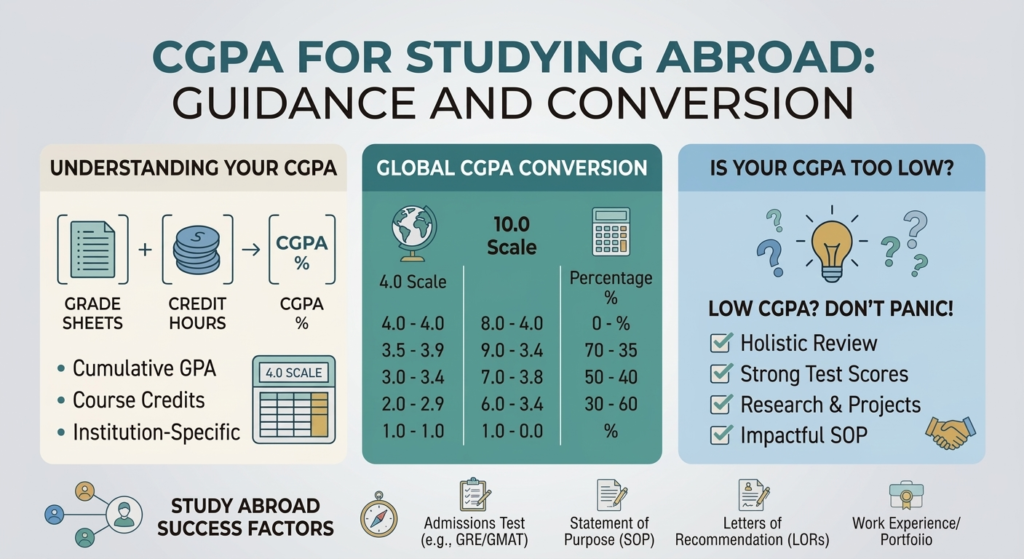
CGPA for studying abroad: Almost every international-admissions thread eventually turns into the same conversation: “how do I even calculate this,” followed immediately by “is my number good enough for a US/UK/Australia program.” This guide walks through both — starting with the calculation basics, then the conversion question, then the real anxiety driving most of these posts: whether a specific CGPA is a dealbreaker for Masters or PhD admission abroad.
Skip the manual math and get your exact figure with our free CGPA Calculator.
How does CGPA calculation actually work?
CGPA for studying abroad is the number every international-admissions thread eventually circles back to. CGPA calculation works the same way almost everywhere, even though the scale (4.0, 5.0, 10.0) differs by country:
- Convert each course’s letter grade into its grade point using your university’s official scale.
- Multiply that grade point by the course’s credit hours.
- Add the weighted totals across every completed semester.
- Divide by your total credit hours attempted.
CGPA = (Σ Grade Point × Credit Hours) ÷ Total Credit Hours
This is the same formula whether you’re calculating a single semester (SGPA) or your full cumulative CGPA — the only difference is how many semesters’ worth of courses you’re including. Our calculator handles the per-semester and cumulative math automatically so you’re not doing it by hand across four years of transcripts.
What is the US GPA equivalent of a 9.0 Indian CGPA (WES-style conversion)?
Getting your CGPA for studying abroad right matters most at the application stage — it’s the first filter admissions committees use before they ever read your SOP. Indian universities commonly grade on a 10-point scale, while US programs use a 4.0 scale. There’s no single official formula — WES (World Education Services) and most US admissions offices use a proportional or percentage-based conversion rather than a fixed multiplier, so results vary slightly by evaluator.
As a rough, widely-used approximation:
- 9.0/10 CGPA ≈ 3.6–4.0 on the US 4.0 scale
- 8.0/10 CGPA ≈ 3.3–3.7
- 7.0/10 CGPA ≈ 2.9–3.3
These are estimates, not guarantees — the exact number depends on which conversion method the specific university or WES evaluation applies. If your target school requires a formal WES (or similar) evaluation, that official report — not a self-calculated estimate — is what admissions committees will actually use.
Is 7.8–7.9 CGPA too low for a Masters in the US, UK, Australia, or Singapore?
No — 7.8–7.9 out of 10 converts to roughly a 3.3–3.6 on the US scale, which comfortably clears the minimum requirement (usually 3.0 equivalent) at the large majority of Masters programs in all four of those countries. It’s not a top-tier score for the most selective programs, but it’s well within the normal admitted range for mid-to-highly-ranked universities.
Will US universities accept a low GPA (around 2.6) from an Indian or Pakistani college for a postgrad program?
A CGPA around 2.6 (roughly 6.5/10 on the Indian scale) is genuinely on the low side for most US Masters programs, which typically ask for a 3.0-equivalent minimum. That doesn’t mean automatic rejection — it means the rest of the application has to work harder to compensate:
- Strong GRE/GMAT scores (where required)
- Relevant work experience or research/publications
- A statement of purpose that directly addresses the low CGPA with context
- Strong letters of recommendation
- Targeting universities with holistic review or no strict GPA cutoff, rather than only top-20 programs
Software engineering and CS applicants with sub-3.0 CGPAs do get admitted every cycle — usually to less GPA-strict programs, or by leading with strong technical portfolios, certifications, or industry experience that outweighs the transcript.
Does a low CGPA for studying abroad also hurt PhD admission in the US?
For PhD programs, CGPA matters less than it does for Masters — research fit, publications, and a strong recommendation from a professor who can vouch for your research potential typically outweigh a borderline CGPA. Admissions committees are largely trying to predict research capability, not undergraduate grade consistency. A low CGPA paired with real research experience (a thesis, published work, or a strong advisor connection) is a far more common admit profile than a high CGPA with no research background.
How can you find Masters in CS programs in the US that accept CGPA below 3.0?
Look specifically for:
- Programs that explicitly list “holistic review” or don’t publish a hard minimum GPA
- Mid-ranked state universities rather than top-20 programs, which tend to have stricter cutoffs
- Programs with a bridge/conditional admission track for borderline applicants
- Schools where your work experience or a relevant certification can be framed as compensating context in your SOP
Cross-reference any shortlist against each program’s official admissions page — GPA minimums (and whether they’re strict or “preferred”) are usually stated there directly, which saves guessing from forum anecdotes. Once you’ve confirmed your CGPA for studying abroad meets a program’s baseline, the rest of your application — test scores, SOP, recommendations — is what actually separates admits from rejections.
Bottom line: Calculating CGPA is a fixed formula, but converting it across country scales is always an estimate until an official evaluation (like WES) is done. A 7.8+ (out of 10) rarely blocks Masters admission abroad; below 3.0-equivalent narrows your options but doesn’t close them, especially for PhD applicants who can lean on research fit instead.