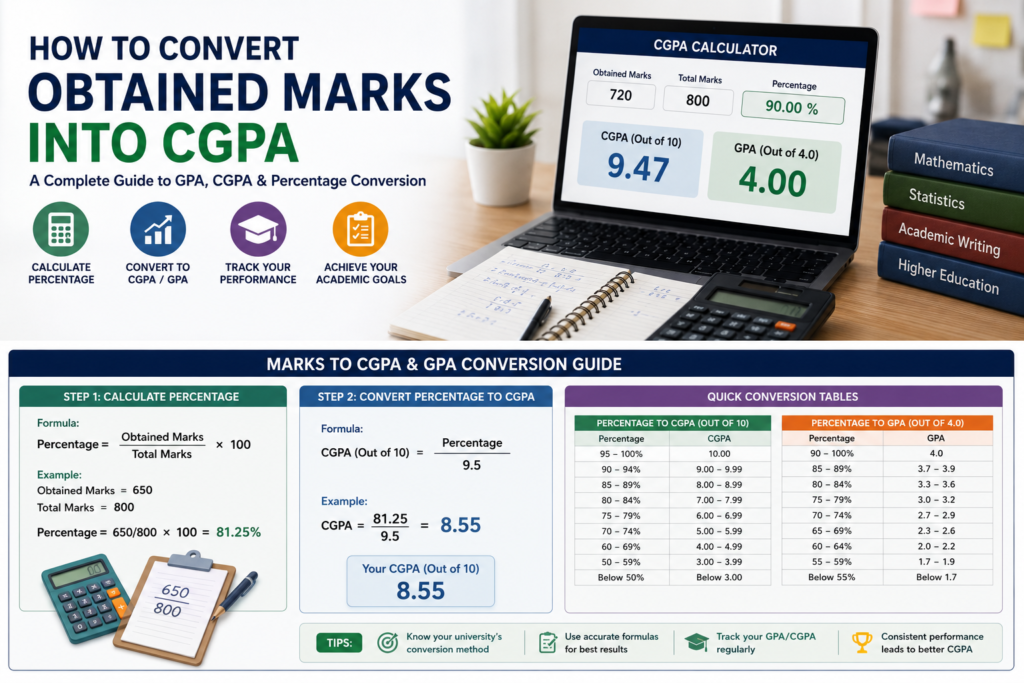
How to Convert Obtained Marks into CGPA
Many students often ask, “How to convert obtained marks into CGPA?” Whether you are applying for university admission, scholarships, internships, or jobs, understanding the conversion process between marks, percentage, GPA, and CGPA is essential.
Different universities and countries use different grading systems. Some use percentages, while others use GPA (Grade Point Average) or CGPA (Cumulative Grade Point Average).
In this complete guide, you will learn how to convert obtained marks into CGPA, calculate GPA, convert percentage into CGPA, and understand the most common grading systems used worldwide.
What Is CGPA and How to Convert Obtained Marks into CGPA?
CGPA stands for Cumulative Grade Point Average.
It is a measure of your overall academic performance across all semesters or academic years.
Unlike percentages, CGPA provides a standardized way to evaluate students’ performance.
Example:
- Percentage = 85%
- CGPA = 8.9 (approximately)
Most universities use either:
- 10-point CGPA scale
- 4-point GPA scale
- Percentage grading system
Step 1: Calculate Your Percentage
Before converting marks into CGPA, you need to calculate your percentage.
Formula
[
Percentage = \frac{Obtained\ Marks}{Total\ Marks} \times 100
]
Example
Suppose you scored:
- Obtained Marks = 720
- Total Marks = 800
Calculation:
[
\frac{720}{800} \times 100 = 90%
]
Result:
720/800 = 90%
Step 2: Convert Percentage into CGPA
Many institutions use the following formula:
[
CGPA = \frac{Percentage}{9.5}
]
Example
[
CGPA = \frac{90}{9.5}
]
[
CGPA = 9.47
]
Result:
90% ≈ 9.47 CGPA
Quick Percentage to CGPA Conversion Table
| Percentage | CGPA |
|---|---|
| 95% | 10.0 |
| 90% | 9.47 |
| 85% | 8.95 |
| 80% | 8.42 |
| 75% | 7.89 |
| 70% | 7.37 |
| 65% | 6.84 |
| 60% | 6.32 |
| 55% | 5.79 |
| 50% | 5.26 |
This table provides approximate CGPA values.
How to Convert Obtained Marks into GPA
Many students applying abroad need GPA instead of CGPA.
Common GPA Scale
| GPA | Academic Standing |
|---|---|
| 4.0 | Excellent |
| 3.7 | Very Good |
| 3.0 | Good |
| 2.0 | Average |
| Below 2.0 | Poor |
Percentage to GPA Conversion Table
| Percentage | GPA |
|---|---|
| 90–100% | 4.0 |
| 85–89% | 3.8 |
| 80–84% | 3.7 |
| 75–79% | 3.3 |
| 70–74% | 3.0 |
| 65–69% | 2.7 |
| 60–64% | 2.3 |
| 55–59% | 2.0 |
| 50–54% | 1.7 |
| Below 50% | Below 1.7 |
These values are estimates and may vary by university.
Marks to CGPA Conversion Example
Let’s understand the process with a practical example.
Student Score
- Obtained Marks = 650
- Total Marks = 800
Step 1: Calculate Percentage
[
\frac{650}{800} \times 100 = 81.25%
]
Step 2: Convert Percentage into CGPA
[
\frac{81.25}{9.5} = 8.55
]
Final Result
| Metric | Value |
|---|---|
| Marks | 650/800 |
| Percentage | 81.25% |
| CGPA | 8.55 |
| GPA | Approximately 3.7 |
Why Universities Use CGPA Instead of Percentage
CGPA offers several advantages:
Standardized Evaluation
Makes comparison easier between students.
International Recognition
Many countries prefer GPA and CGPA systems.
Semester-Based Assessment
Reflects long-term academic performance.
Reduced Marking Variations
Minimizes differences between grading systems.
Common Methods Used to Convert Marks into CGPA
Different institutions may use different conversion formulas.
Method 1: Percentage ÷ 9.5
Most commonly used.
Method 2: University-Specific Formula
Some universities have their own CGPA conversion systems.
Method 3: Credit Hour-Based CGPA
Many colleges calculate CGPA based on grades and credit hours rather than percentages.
Always check your university’s official guidelines.
CGPA to Percentage Formula
Students often need the reverse calculation.
Formula
[
Percentage = CGPA \times 9.5
]
Example
CGPA = 8.5
[
8.5 \times 9.5 = 80.75%
]
Result:
8.5 CGPA = 80.75%
Common Mistakes When Converting Marks into CGPA
Avoid these errors:
Using the Wrong Formula
Different universities may use different methods.
Ignoring Credit Hours
Some CGPA calculations depend on course credits.
Rounding Errors
Always keep two decimal places.
Assuming Universal Standards
There is no single worldwide CGPA conversion formula.
Benefits of Knowing Your GPA and CGPA
Understanding GPA and CGPA helps students:
- Apply for scholarships
- Track academic progress
- Prepare for higher studies
- Meet university admission requirements
- Improve career opportunities
Frequently Asked Questions
How to convert obtained marks into CGPA?
First calculate your percentage and then divide it by 9.5 if your institution follows the standard 10-point CGPA system.
Can I convert marks directly into CGPA?
Usually, marks are first converted into percentage and then into CGPA.
Is GPA the same as CGPA?
No.
- GPA measures performance in one semester.
- CGPA measures overall performance across all semesters.
What is the easiest way to calculate CGPA?
Using an online CGPA calculator is the fastest and most accurate method.
How do I convert percentage into GPA?
Use a GPA conversion chart or your university’s official GPA conversion method.
Final Thoughts
Understanding how to convert obtained marks into CGPA is important for every student. Whether you’re calculating percentage, GPA, CGPA, or preparing applications for universities and scholarships, knowing the correct conversion process can save time and prevent mistakes.
The general process is simple:
- Calculate percentage from obtained marks.
- Convert percentage into CGPA.
- Use GPA conversion tables if required.
For quick and accurate calculations, use a reliable CGPA Calculator, GPA Calculator, Percentage to CGPA Converter, or Marks to CGPA Calculator on your website CGPACal.com.